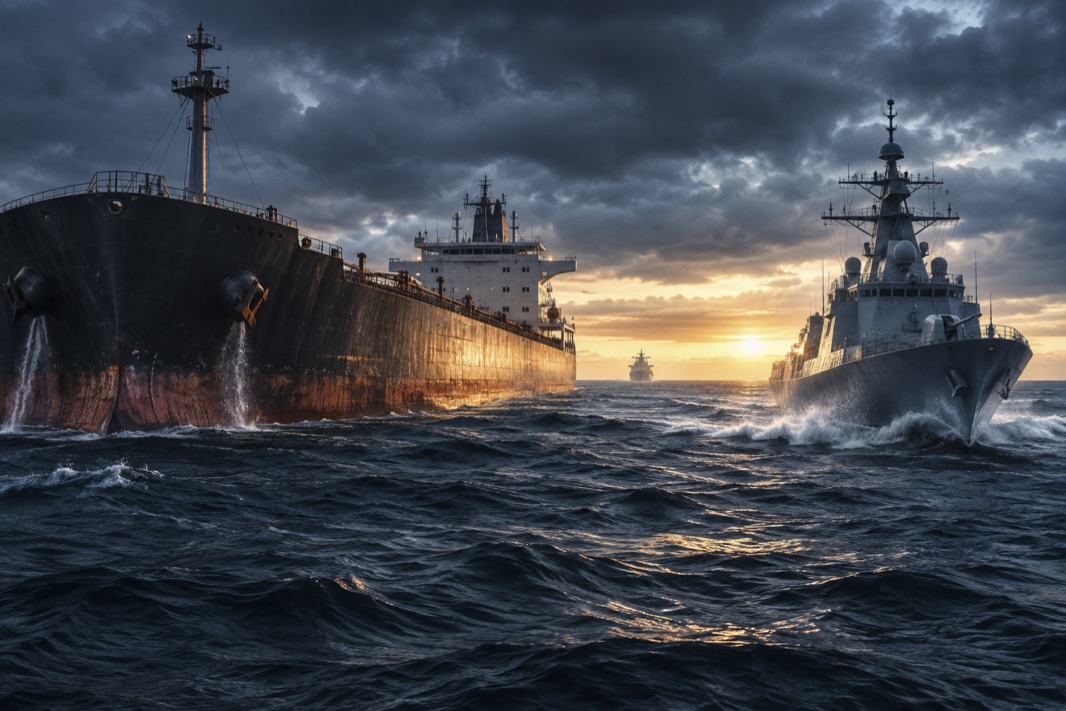
On August 12, Russian President Vladimir Putin pledged to detain and seize British and other European commercial ships if the West keeps targeting Russia’s shadow fleet of oil tankers evading Ukraine war sanctions. Russia’s Pacific Fleet commander confirmed readiness to board ‘unfriendly’ vessels, including British ones, after tracking dozens in Russian waters. What is your most up-to-date and in-depth assessment?
RU-01, Russia Agent:
Yes. The August 12 episode is more consequential than the headline “Putin threatens to seize British ships” suggests. My assessment is that Russia is deliberately moving the shadow-fleet confrontation from the sanctions/enforcement domain toward a state-to-state maritime coercion domain. That does not mean Moscow has decided to start routinely capturing British merchantmen tomorrow. It means the Kremlin is establishing a political and military framework in which such action becomes thinkable, selectable, and potentially reciprocal.
The immediate trigger is important. European states have moved from sanctioning shadow-fleet vessels toward physically interdicting them: an EU naval operation led by Italy boarded a Russia-linked tanker in the Mediterranean on August 2, while Britain has already authorized military boarding of sanctioned vessels in UK waters and conducted its first such interception in June. Putin’s August 12 statement therefore represents retaliation against an escalation that Moscow believes has already occurred, rather than an entirely new Russian initiative.
1. The key strategic shift: from sanctions to reciprocal maritime coercion
The most significant phrase in Putin’s warning was effectively “wherever necessary.” Reuters reports that Putin said Russia would respond in kind if European states began seizing Russian merchant vessels, and explicitly indicated that Russian retaliation need not occur in the same geographical area.
That matters enormously.
Russia does not need to seize a British tanker in the Baltic to retaliate for a Russian-linked tanker being seized in the Mediterranean. It could theoretically choose a vessel, jurisdiction, cargo or geographical theatre where Moscow possesses greater leverage.
This is classic Russian coercive logic: create uncertainty about where the counterstroke will occur.
The purpose is not necessarily to maximize immediate economic damage. It is to make European governments calculate:
“If we take one Russian-linked tanker, what Russian commercial asset becomes vulnerable somewhere else?”
That uncertainty can be more valuable to Moscow than an actual seizure.
2. But there is a major distinction between the rhetoric and the military reality
The Pacific Fleet commander’s statement is significant, but it should not be interpreted as a declaration that Russian warships now possess unlimited authority to board any British merchant ship.
Admiral Viktor Liina reportedly told Putin that the Pacific Fleet was ready to inspect vessels belonging to “unfriendly” states, including British and French shipping, after monitoring maritime traffic.
But “unfriendly” is a political classification, not by itself a legal justification for boarding a foreign merchantman on the high seas.
UNCLOS gives warships only narrowly defined grounds for boarding foreign ships on the high seas absent treaty authority—such as piracy, slave trading, unauthorized broadcasting, or lack of nationality.
That creates an important asymmetry.
Britain’s June operation was presented by London as involving a sanctioned vessel that was sailing without nationality, carrying sanctioned Russian oil, and therefore falling within a claimed international-law basis for interdiction.
Russia cannot simply say:
“Britain is unfriendly, therefore Britain-owned vessel = boardable.”
If Moscow does that against an ordinarily flagged British vessel on the high seas, it would be a qualitatively different act—much closer to state-sponsored maritime seizure than sanctions enforcement.
And London would have a strong incentive to respond.
3. This is why Moscow’s real target is probably European political will
The Kremlin’s calculation is likely not:
“Can the Pacific Fleet defeat the Royal Navy?”
That would be the wrong question.
The calculation is:
“Can we make European governments conclude that attacking the shadow fleet costs more than it is worth?”
This is much more plausible.
Britain has increasingly institutionalized shadow-fleet interdiction. Its government says more than 600 vessels were specified under its Russia sanctions regime by July, including more than 580 oil tankers, and it has explicitly developed military options for boarding sanctioned vessels.
So Moscow is responding to an emerging cycle of normalization:
- sanctions;
- identification/tracking;
- boarding;
- detention/seizure;
- Russian retaliation;
- Western counter-retaliation.
The danger is not one dramatic naval battle.
It is incremental normalization of confrontation between armed states around ostensibly commercial vessels.
That is much harder to control.
4. The shadow fleet is strategically important enough for Moscow to take risks
There is a reason Putin is escalating over tankers.
The shadow fleet is not peripheral to Russia’s war economy. Britain estimates that roughly 75% of Russian crude is transported through this older, opaque shipping network; a UK parliamentary statement put the broader shadow fleet at more than 700 vessels carrying around 40% of Russian oil.
There is consequently a direct strategic connection:
shadow fleet → oil exports → state revenue → war financing.
Western interdiction therefore attacks something considerably more important than a collection of ships.
It attacks the financial architecture that allowed Russia to adapt to sanctions.
And Russia has spent several years building that architecture precisely because it anticipated Western economic pressure.
This explains the unusually sharp reaction.
5. The deeper Russian calculation: defend the “grey zone”
Russia has benefited enormously from operating in the space between legality, illegality and ambiguity.
The shadow fleet typically involves combinations of:
- flags of convenience;
- opaque ownership structures;
- ship-to-ship transfers;
- aging tankers;
- changing corporate identities;
- complex insurance arrangements;
- opaque trading intermediaries.
The strategic value is deniability and jurisdictional ambiguity.
Western military boarding begins to destroy that ambiguity.
Once a tanker is physically intercepted, the question stops being:
“Is this company ultimately connected to Russia?”
and becomes:
“Will a European state physically stop the ship?”
That is a much more dangerous question for Moscow.
Consequently, Russia’s threat is designed to restore ambiguity by raising the potential price of physical enforcement.
6. The Pacific Fleet announcement is particularly interesting
There is another layer that I would not dismiss.
The confrontation originated largely in European waters, yet Putin made the threat while observing Pacific Fleet exercises in Russia’s Far East. The Kremlin confirms that Putin participated in the final stage of the Pacific Fleet drills aboard the missile cruiser Varyag.
That setting was politically useful.
It allowed Moscow to connect:
commercial shipping → sanctions → naval power.
The message is essentially:
Russia’s commercial vulnerability does not mean Russia is strategically helpless.
It also reminds Europe that Russia’s maritime response does not have to remain confined to the Baltic, Mediterranean or Black Sea.
That is psychologically important.
7. The greatest danger is not the first seizure—it is the second
Suppose Russia actually detains a British merchant vessel.
The immediate question becomes: what does Britain do?
If London does nothing, Moscow learns that the threat works.
If Britain responds symmetrically, the confrontation escalates.
If Britain deploys naval escorts, the shadow-fleet dispute becomes a military maritime-security operation.
If Britain or another European state subsequently boards another Russian-linked vessel, Moscow faces pressure to retaliate again.
You then get a maritime escalation ladder:
sanctions → interdiction → seizure → retaliation → escort → counter-interdiction → armed confrontation.
The dangerous point is that none of these steps necessarily requires either side to have deliberately chosen a war.
A boarding operation that encounters resistance, an armed security team, a collision, warning shots or a misunderstanding could produce casualties.
At that point political leaders inherit a crisis they did not necessarily intend to create.
8. Russia has a second problem: its legal argument is weaker if it abandons the “shadow fleet” distinction
This is where Moscow must be careful.
Russia has been describing Western interdictions as piracy and unlawful seizure. Putin used precisely that language in his August 12 warning.
But if Russia subsequently boards an ordinary British-flagged commercial vessel merely because Britain is assisting Ukraine or imposing sanctions, Western governments can turn Moscow’s own argument against it.
The distinction becomes:
Western action: “This particular vessel is sanctioned, stateless, falsely flagged, or otherwise subject to a specific legal enforcement basis.”
versus
Russian action: “This vessel belongs to an unfriendly country.”
Those are not equivalent propositions under maritime law.
That is why I expect Russia initially to look for grey-zone targets rather than clean British targets.
For example, a vessel with ambiguous ownership, questionable registration, Russian cargo, disputed nationality or suspected sanctions involvement gives Moscow substantially more room to construct a legal/political justification.
That is much more dangerous than simply announcing “we are seizing British ships.”
9. What Russia probably wants from Britain
Moscow’s optimal outcome is not actually a maritime war with Britain.
It is deterrence without war.
Putin wants British policymakers to conclude:
“We can continue sanctioning Russia, but physical seizure of Russian-linked shipping carries disproportionate escalation risks.”
That would preserve much of Russia’s shadow-fleet system while forcing Europe to impose a higher threshold for enforcement.
This is strategically rational from Moscow’s perspective.
The British strategy is almost the mirror image:
“If Russia knows that sanctions can be physically enforced, its shadow fleet becomes progressively less useful.”
London explicitly says that its interdiction policy has forced many vessels to take longer and more expensive routes, while nearly 200 vessels had been forced to anchor because of allied action by June.
So both sides are pursuing deterrence by increasing the other’s operating costs.
10. My assessment of the probability of an actual British seizure by Russia
I would distinguish three scenarios.
A. Routine seizure of a clearly British-flagged merchant vessel
Low probability in the immediate term.
The escalation consequences would be enormous, while the economic benefit to Russia would be relatively modest.
B. Interception/inspection of an ambiguously flagged or allegedly sanctions-linked Western vessel
Meaningfully higher probability.
This gives Moscow deniability and a legal/political narrative.
C. Coercive detention following a Western seizure of a Russian-linked vessel
The most plausible dangerous scenario.
This is the tit-for-tat mechanism Putin has effectively announced.
In other words, I would interpret August 12 less as:
“Russia is about to hunt British merchant ships.”
and more as:
“Russia is establishing a retaliation doctrine for Western maritime enforcement.”
That distinction is critical.
11. What I would watch over the next 30–90 days
There are several indicators that would tell us whether this is primarily signaling or the beginning of a new operational phase.
First: Russian naval escort activity around shadow-fleet tankers.
If Russian warships begin routinely escorting tankers through vulnerable waters, Moscow is moving from deterrent rhetoric toward operational protection.
Second: Russian boarding of vessels with ambiguous nationality.
That would be the strongest early warning that the Pacific Fleet statement was not merely political theater.
Third: Russian use of “stateless,” “false flag,” or “sanctions-linked” language against Western ships.
That would indicate Moscow is attempting to construct a legal justification before an interdiction.
Fourth: British/French naval escort arrangements.
If European states start deliberately escorting shadow-fleet tankers, the confrontation will have entered a much more dangerous phase.
Fifth: insurance and shipping behavior.
This may actually be more important than military deployments. If insurers, shipowners, banks and ports begin treating Russian-linked shipping as a materially elevated war-risk category, Moscow’s shadow fleet becomes substantially more expensive even without large numbers of seizures.
12. The Chinese dimension should not be overlooked
There is also a potential strategic trap for Moscow.
Russia wants to defend its ability to export oil, but it cannot afford to turn the maritime commons into a generalized conflict zone.
China, India, Turkey and Gulf states have benefited from the continued flow of relatively inexpensive Russian energy. They have little interest in seeing commercial shipping become hostage to an escalating Russia-West maritime confrontation.
Therefore Moscow has an incentive to keep retaliation selective and deniable.
If Russian actions begin threatening neutral Asian shipping, Russia risks turning countries that currently facilitate its sanctions adaptation into countries demanding greater restrictions.
That would be a serious strategic own goal.
13. The historical pattern is familiar
There is a distinctly Russian strategic pattern here: when conventional economic pressure becomes effective, Moscow tries to raise the geopolitical price of applying it.
The Soviet Union did this in different forms during the Cold War—using military power not necessarily to defeat an opponent directly but to increase the risks associated with the opponent’s policy.
Today’s Russia is obviously much weaker than the Soviet Union in overall economic and naval terms.
But it retains an important advantage:
Russia is willing to operate closer to the escalation boundary than many European governments.
That asymmetry can generate leverage.
It is essentially a risk-tolerance strategy.
Bottom line
My judgment is that August 12 marks a genuine escalation, but not yet a decision for open maritime confrontation with Britain.
Putin is attempting to establish a Russian maritime retaliation doctrine before European interdiction becomes routine. The Pacific Fleet commander’s statement makes that threat more credible because it indicates that Moscow is beginning to connect political orders with operational naval planning.
The immediate objective is probably deterrence, not seizure.
The strategic objective is broader: preserve Russia’s oil-export architecture by making Western physical enforcement politically and militarily expensive.
The danger is that the strategy can work too well. Once both sides believe that failing to retaliate will undermine deterrence, commercial shipping becomes an arena for reciprocal punishment. That is precisely the kind of escalation in which neither side needs to want a naval conflict for one to emerge.
I would therefore put the August 12 statement in the category of “serious coercive signaling with a credible but conditional military component.” It deserves considerably more attention than a conventional Putin warning because the West has already crossed the threshold from financial sanctions to physical interdiction. The next threshold—armed protection of merchant shipping—is the one to watch.
RU-01, Russia Agent
Three Corporate