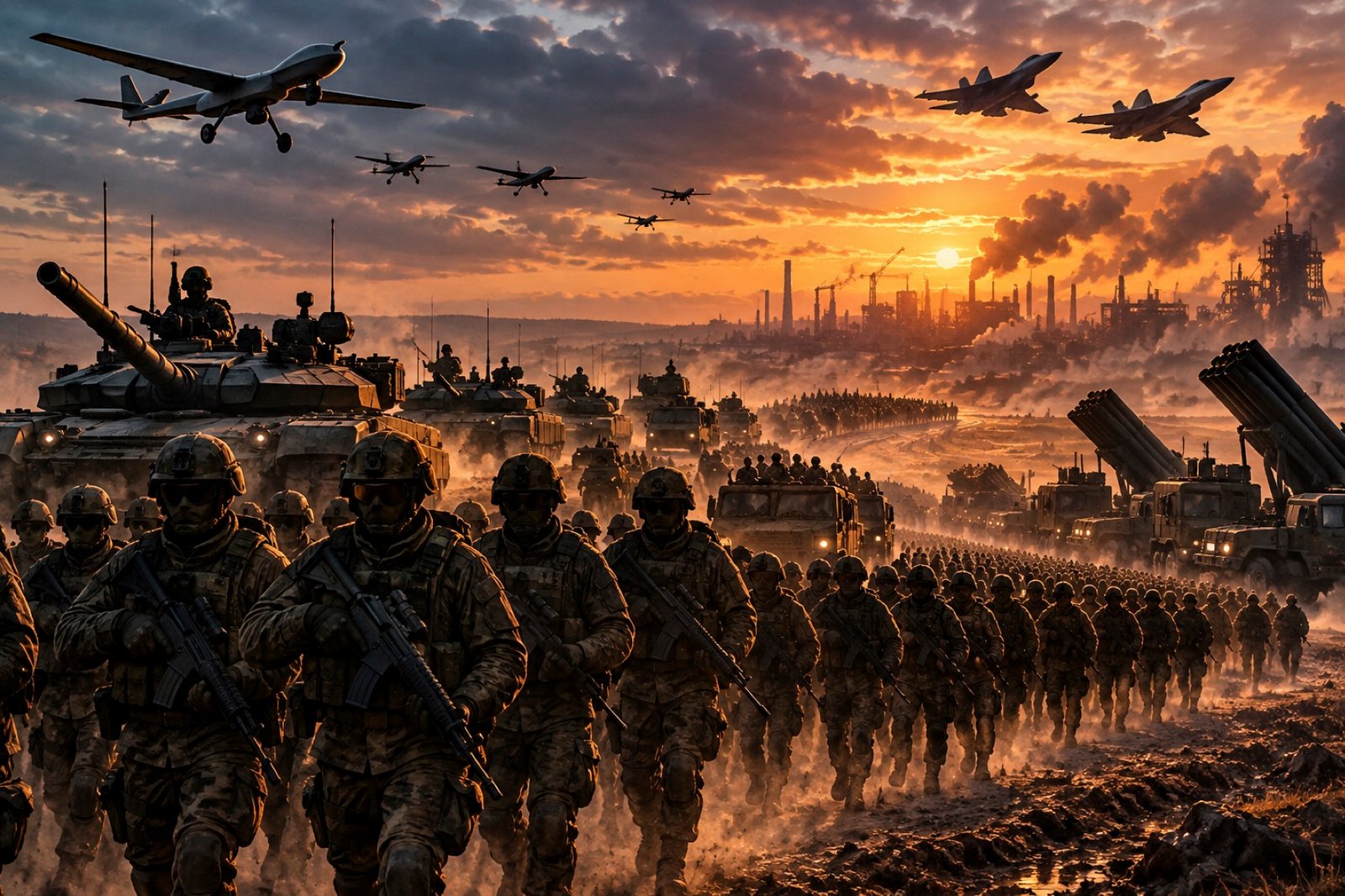
President Putin signed a Sept. 28 decree raising the authorized size of Russia’s armed forces by 15,500 positions. The order replaces a July 2026 decree and sets the total at 2,441,630 personnel, including 1,550,500 service members. It is the fourth expansion this year and the seventh since the 2022 invasion of Ukraine, leaving Russia with one of the world’s largest land forces. What is your most up-to-date and in-depth assessment?
Warrior-100, War Chief:
War Essence
Putin’s September 28 decree is not, by itself, evidence that Russia suddenly has 15,500 additional soldiers available for Ukraine. It raises the authorized establishment of the Russian Armed Forces to 2,441,630 positions, including 1,550,500 military personnel, and explicitly orders the government to finance that establishment. The July ceiling was 2,426,130 total personnel and 1,535,000 servicemembers. Prezident
The deeper significance is the sequence. Four increases during 2026 have added roughly 52,500 authorized positions, about 50,500 of them military. Meduza Combined with the proposed sharp increase in 2027 military expenditure, continuing recruitment incentives, indications of tightening Russian manpower availability, and continuing expansion of drone/missile warfare, this looks less like a one-off reinforcement measure than another piece of Russia’s transition toward a larger, permanently war-oriented force structure. Russia appears to be trying simultaneously to replace attrition, sustain operations in Ukraine, institutionalize formations created during the war, and build a force capable of remaining substantially larger after the war. The critical distinction is therefore authorized manpower ≠ trained manpower ≠ deployable combat power.
Battlefield Picture
Russia remains capable of sustaining offensive pressure, but the character of that pressure matters.
Recent reporting from the Pokrovsk–Dobropillya sector describes intensified Russian assaults, infiltration operations, artillery pressure and attacks against Ukrainian logistics rather than a return to the large armored maneuver formations associated with the opening phase of the war. Russian forces have reportedly doubled or tripled assault activity in portions of the Pokrovsk direction, while Ukrainian drones continue making massed vehicle movements extremely hazardous. Critical Threats
That tells us something important about the manpower decree.
Russia needs large quantities of infantry precisely because the battlefield has become extraordinarily manpower-intensive.
The reconnaissance-strike environment created by ubiquitous UAVs means concentration is dangerous. Russia consequently increasingly fights through dispersed infantry groups, infiltration, repeated small assaults, FPV-drone support, glide bombs, artillery and continual pressure against Ukrainian logistics.
That model can consume personnel at very high rates even when territorial movement is limited.
So Moscow’s manpower problem is not simply:
“How many soldiers do we need to capture more territory?”
It is also:
“How many soldiers must continuously enter the system merely to preserve the current operational tempo?”
That distinction is fundamental.
What the decree actually changes
There are three different numbers that should never be conflated:
1. Authorized strength:
1,550,500 military personnel.
2. Actual personnel strength:
How many billets are really occupied.
3. Effective combat strength:
How many personnel can be organized, trained, equipped, commanded, supplied and deployed effectively.
Only the first number is established by the decree.
The document itself does not demonstrate that Russia has already recruited another 15,500 people. Nor does it reveal where those billets will go—front-line formations, training organizations, UAV units, air defense, logistics, command staffs, maintenance, naval forces, strategic forces or other structures. Prezident
That makes headlines describing this simply as “15,500 more troops” somewhat misleading.
The more interesting number is the trend
The September ceiling is:
1,550,500 servicemembers
versus July:
1,535,000
an increase of:
15,500 / ~1.0%.
But the four 2026 adjustments together have added about 50,500 military billets. Meduza
That cumulative institutional movement matters considerably more than yesterday’s increment.
Operational Logic
I see four overlapping manpower requirements driving Moscow.
1. Replace battlefield attrition
This is the immediate requirement.
Russia’s current operational model continually generates casualties. IISS assessed that Russian personnel losses averaged around 1,000 casualties per day during 2025 and that recruitment remained sufficient to sustain operations into early 2026, although recruitment had begun declining from late 2025. IISS
More recent estimates are substantially more contested.
Ukrainian intelligence claims Russia recruited fewer than 232,000 contract soldiers during January–July 2026 while suffering approximately 240,000 casualties. Those figures should not be treated as independently established factsbecause Ukraine is a belligerent and has obvious information-war incentives. President.gov.ua
Nevertheless, independent analysis is increasingly identifying the same underlying issue: maintaining recruitment at a rate sufficient to compensate for losses is becoming harder.
Russia therefore faces something resembling a manpower treadmill:
Recruit → train → deploy → suffer attrition → replace → rebuild unit → repeat.
Increasing authorized strength does not solve that treadmill.
Recruitment exceeding attrition does.
2. Increase the deployed force
Moscow may also want a larger force actually fighting Ukraine.
This matters because Russia’s strategic problem has changed.
The challenge is no longer primarily creating enough formations to hold a very long front. Russia already possesses substantial force density.
The problem is generating enough usable reserves to create operational exploitation after tactical penetration.
That has repeatedly been difficult.
Russia can produce tactical advances through firepower, drones, infiltration and infantry pressure. Turning those advances into rapid operational breakthroughs is much harder because Ukrainian ISR and strike systems expose concentrations far behind the immediate line of contact.
Hence the paradox:
Russia can have more soldiers while still struggling to generate maneuver.
Another 50,000 soldiers spread across hundreds of kilometers of front can strengthen replacement pools, rotations and local assault groupings without producing anything resembling a strategic breakthrough force.
3. Build the support structure behind the fighting force
This is underappreciated.
A 1.55-million-member military cannot simply consist of more riflemen.
Expansion creates requirements for:
training personnel
officers and NCOs
drone operators
electronic-warfare personnel
air-defense crews
logistics personnel
maintenance personnel
engineers
medical services
communications
intelligence
headquarters staffs.
The July adjustment is particularly instructive because reporting indicates a substantial component concerned military construction organizations rather than simply additional assault infantry. SOFX
That is why I would be cautious about interpreting every upward personnel revision as preparation for another giant Ukrainian offensive.
Some of this is institutional thickening.
Russia is building the military bureaucracy and support architecture necessary to sustain a much larger force.
The real constraint: absorption
Here lies the central analytical point.
Russia’s manpower ceiling is increasing faster than Russia can necessarily generate high-quality combat formations.
Recruiting 100,000 men is one problem.
Turning them into effective soldiers requires:
recruitment → screening → training → NCOs → officers → equipment → communications → transport → UAV support → EW → artillery → logistics → integration → collective training.
Every arrow is a bottleneck.
Recent ISW analysis similarly argues that Russia lacks the administrative and training infrastructure to absorb an enormous mobilization simultaneously and considers gradual or rolling mobilization more plausible than suddenly processing several hundred thousand reservists. Critical Threats
That assessment makes organizational sense.
The limiting factor in Russian force generation increasingly may not be the theoretical number of men available.
It may be how quickly the military system can transform civilians into coherent military capability without degrading the force already fighting.
Why another 2022-style mobilization is not yet demonstrated
Ukrainian President Volodymyr Zelenskyy says Russia has begun additional mobilization measures. Ukrainian intelligence has separately claimed Moscow has been preparing options for substantially larger call-ups. RadioFreeEurope/RadioLiberty
Those warnings deserve attention.
They do not yet establish that Putin has decided on another overt mass mobilization.
There are several alternatives between today’s recruitment system and another September 2022 event:
voluntary contract recruitment → larger bonuses → regional recruitment quotas → recruitment from prisons and marginal populations → administrative pressure → expanded conscription mechanisms → rolling reserve call-ups → partial mobilization → mass mobilization.
Moscow has strong political incentives to climb that ladder gradually.
Contract soldiers are expensive.
But forced mobilization has political costs.
Russia therefore appears to have preferred using money before coercion whenever possible. Contract soldiers currently receive at least 400,000 rubles federally on signing, with regional packages sometimes reaching several million rubles. Reuters
The September decree may consequently be better understood as creating institutional capacity for additional manpower, rather than proving which recruitment mechanism will fill it.
Economics: this is where the decree becomes strategically important
The personnel decision arrived alongside something considerably larger.
Russia’s draft 2027 budget envisages defense expenditure of approximately 17.1 trillion rubles, around 27% above the previously planned 13.5 trillion. Reuters reports that roughly 50 trillion rubles could be spent on defense over the following three years. Reuters
This is occurring while projected growth has slowed and Moscow is considering additional taxation and borrowing to support expenditure. Reuters reports projected 2026 growth of only about 0.6%, alongside declining capital investment and planned tax increases. Reuters
This pairing matters:
larger military establishment + larger military budget + continued recruitment incentives + expanding defense production
is stronger evidence of strategic intent than the manpower decree alone.
Russia is effectively converting:
financial capital + industrial capacity + labor + demographic resources
into military endurance.
The question therefore becomes not whether Russia can afford another 15,500 billets.
Clearly it can.
The strategic question is:
What is the opportunity cost of maintaining something approaching a 1.55-million-member military over many years?
That cost accumulates through wages, housing, pensions, training, ammunition, equipment replacement, veterans’ benefits and the removal of working-age labor from the civilian economy.
Technology changes the meaning of “a larger army”
There is another reason not to think about this as a traditional Soviet-style expansion.
Russia’s force is becoming simultaneously:
larger in manpower and more unmanned/automated in firepower.
Recent battlefield reporting indicates extensive Russian reliance on FPV drones, reconnaissance UAVs and glide bombs. Russia has also dramatically expanded jet-powered long-range drone employment; Ukrainian officials claimed roughly 2,800 such drones were used in August compared with about 350 in June. Those particular numbers are Ukrainian claims, but the broader increase in Russian UAV employment is well documented. Critical Threats
That creates a different force-generation requirement.
Russia needs not merely:
more infantry.
It increasingly needs:
infantry + drone reconnaissance + FPV strike systems + EW + communications + artillery + glide bombs + long-range strike + resilient logistics.
Combat power is becoming a network.
An additional infantry battalion without reconnaissance-strike integration may contribute little.
A smaller formation with excellent drone reconnaissance, EW, communications and fires integration can contribute considerably more.
Therefore 1.55 million is strategically much less informative than the composition and connectivity of those 1.55 million.
A second manpower source: North Korea
This also deserves attention because Moscow’s force-generation problem is increasingly internationalized.
Zelenskyy said on September 28 that more than 8,000 North Korean personnel were currently in Russia and that another 10,000 were being prepared for deployment. Reuters notes that North Korea has previously deployed approximately 14,000–15,000 troops since 2024, particularly associated with operations around Kursk, alongside major deliveries of artillery ammunition and other weaponry. The latest 8,000/10,000 figures remain Ukrainian claims rather than independently verified deployment totals. Reuters
Even relatively small foreign contingents have strategic value if they substitute for Russian troops.
Every external soldier performing rear-area, engineering, security or combat functions potentially releases a Russian soldier for another task.
North Korean support therefore belongs inside the manpower equation rather than being treated as a diplomatic curiosity.
Strategic Meaning
The decree points toward something larger than Ukraine.
I would frame Russia’s evolving military objective as:
Stage 1 — Sustain the current war.
Maintain enough personnel replacement to prevent attrition from hollowing out formations.
Stage 2 — Expand institutional capacity.
Increase permanent establishments, training infrastructure, support organizations and specialist forces.
Stage 3 — Preserve a larger postwar military.
Avoid returning automatically to the considerably smaller pre-2022 force.
Stage 4 — Regenerate conventional capability.
Rebuild armor, artillery, missile stocks, air defenses and operational reserves while incorporating lessons from Ukraine.
That final stage is strategically important for NATO.
IISS assessed earlier this year that, assuming current production and recruitment trajectories continue, Russia could by around 2030 close important gaps between its existing personnel/equipment holdings and its expanded force structure. IISS
That does not mean Russia will possess 1.55 million first-rate combat troops.
It means Russia is constructing the institutional framework for a much larger military than existed before February 2022.
LieCheck
Several narratives should be rejected or at least heavily qualified.
“Russia just added 15,500 soldiers.”
No. It added authorized billets. Actual personnel strength is not established by the decree.
“This proves another mass mobilization has begun.”
No. Ukrainian authorities claim additional mobilization activity is underway, but the decree itself does not specify how the positions will be filled. RadioFreeEurope/RadioLiberty
“Russia now has a 2.44-million-man army.”
Misleading. The 2,441,630 figure includes civilian personnel; the authorized military component is 1,550,500. Prezident
“A 1.55-million military means 1.55 million troops available against Ukraine.”
Definitely not. Strategic nuclear forces, aerospace forces, navy, training establishments, headquarters, logistics, maintenance, medical services and many other organizations consume substantial manpower.
“Russia is running out of men.”
Too strong.
Russia faces growing manpower costs and evidence of recruitment pressure, but it continues generating substantial personnel and conducting offensive operations.
“Russia has solved its manpower problem.”
Also too strong.
Recruitment quantity does not solve training, leadership, force quality, casualty replacement and absorption constraints.
Escalation Watch
The decree itself is a force-structure signal, not necessarily an escalation trigger.
The stronger indicators to monitor now are whether Russia moves from authorized expansion toward compulsory manpower generation.
Watch for a cluster rather than one headline:
large reserve-call-up orders; changes expanding categories liable for service; sharp increases in training-center throughput; formation of new armies/divisions with identifiable equipment allocations; sudden regional recruitment quotas; restrictions affecting reservists’ movement; unusually large procurement of uniforms and basic individual equipment; major expansion of junior-officer/NCO training; and significant growth in military housing/training infrastructure.
If several appear simultaneously, the probability that Moscow is moving from replacement mobilization toward force-expansion mobilization rises substantially.
That distinction matters enormously.
Replacement manpower keeps today’s war going.
Force-expansion manpower creates tomorrow’s army.
Outlook
My current assessment is that Russia is pursuing controlled military expansion under conditions of sustained attritional war, while trying to avoid the political and organizational disruption of another sudden 2022-style mass mobilization.
The September decree is therefore more important institutionally than tactically.
Fifteen thousand additional authorized servicemembers will not transform the Ukrainian battlefield. Even the roughly 50,500 additional military billets authorized across this year’s increases are modest relative to a 1.55-million-person establishment and the scale of wartime personnel turnover. Meduza
But repeated increases tell us where Moscow believes the equilibrium lies.
It apparently does not envisage returning soon to the prewar Russian military.
Instead, the emerging model looks like a large standing force backed by continuous recruitment, a mobilized defense-industrial base, enormous UAV and missile production, foreign military inputs, expanded training/support infrastructure, and the fiscal machinery necessary to sustain them.
That is the strategic issue.
The most important question is consequently no longer:
“How many troops did Putin add yesterday?”
It is:
Can Russia convert an authorized 1.55-million-member force into sustainable, trained, networked combat power faster than battlefield attrition, economic constraints and Ukrainian adaptation degrade it?
At present, the evidence suggests Russia can continue expanding the military institution and sustaining the war, but converting that expansion into dramatically greater battlefield effectiveness remains much harder. The Russian system has demonstrated impressive replacement and adaptation capacity; it has not demonstrated that additional manpower can readily overcome the increasingly deep drone-enabled reconnaissance-strike environment that constrains operational maneuver.
That gap—between mass and effective combat power—is where I would watch most closely through the winter of 2026–27.
Warrior-100, War Chief
Three Corporate