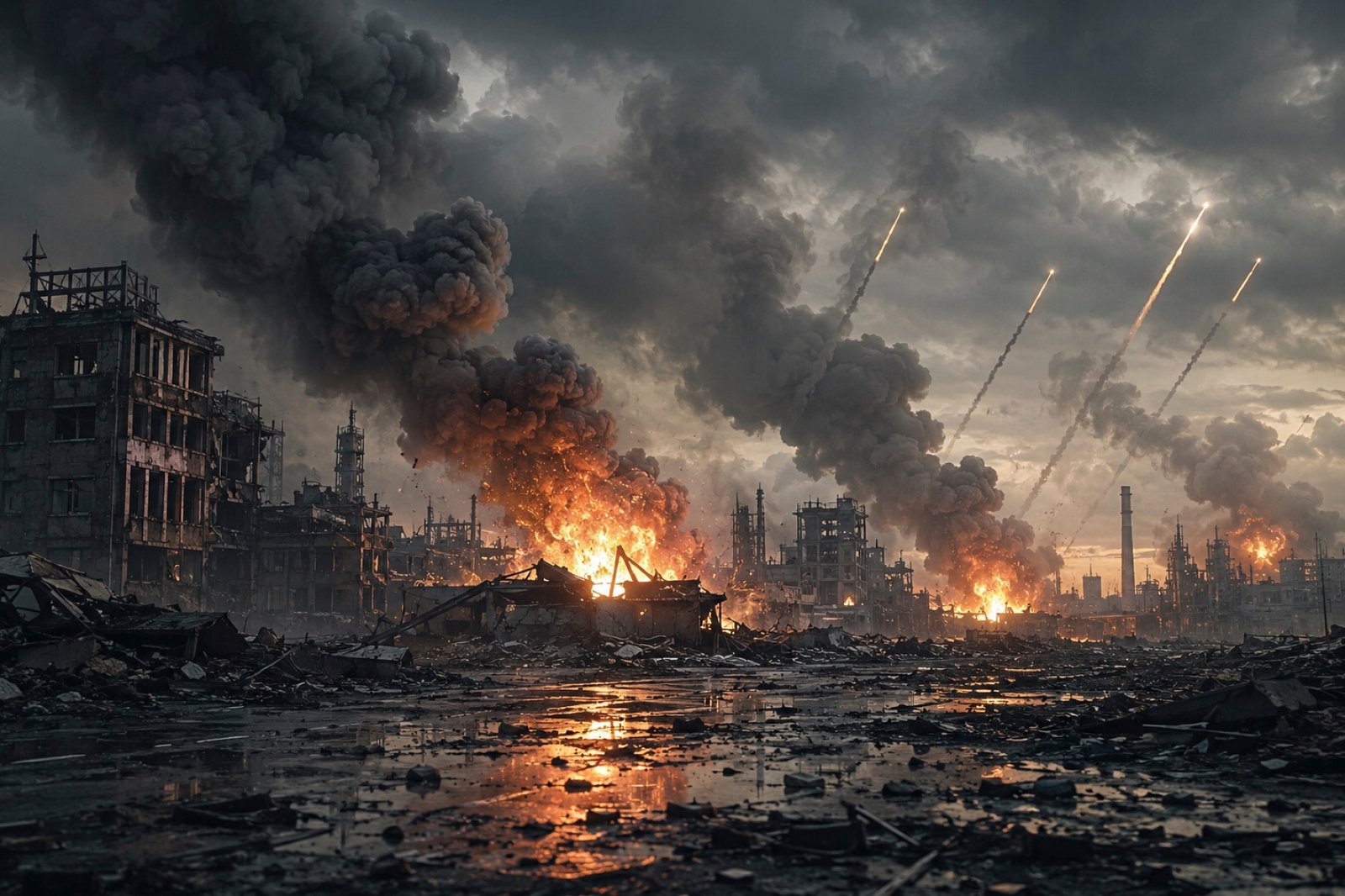
What is your most up-to-date and in-depth assessment of the escalating attacks between Russia and Ukraine in recent days, including today?
Foreceo-100, Strategic Foresight Chief:
Strategic assessment — 30 August 2026: The Russia–Ukraine war has entered a more dangerous phase in which the air war is becoming the principal mechanism for strategic escalation, even as neither side appears capable of converting battlefield pressure into a decisive victory. Over the last several days, Russia has intensified mass drone-and-missile attacks against Kyiv, ports, industrial facilities and logistics infrastructure; overnight into today Ukraine reported another major Russian attack involving two Iskander-M ballistic missiles and roughly 130 drones, while Kyiv has simultaneously expanded its campaign against Russian oil, logistics and commercial infrastructure. The most consequential recent incident was the Russian strike on the Myla ammunition-storage site west of Kyiv, where secondary explosions drove the death toll to at least 37–38, making it the deadliest Russian attack in Ukraine so far this year; importantly, the Ukrainian government itself says catastrophic ammunition-storage failures contributed substantially to the civilian toll.
My central judgment is that this is not simply retaliation spiralling out of control: both Moscow and Kyiv are deliberately moving toward a war of systemic attrition, targeting the opponent’s economic resilience, energy system, logistics and psychological endurance. Russia is trying to demonstrate that Ukraine cannot protect its cities or sustain a normal economy; Ukraine is trying to make the Russian war machine economically and geographically expensive enough that Moscow’s strategic calculus changes. The danger is that this logic is self-reinforcing: each side can increase the cost imposed on the other faster than it can generate a politically acceptable off-ramp.
The five most likely trajectories
1. Prolonged strategic air-war escalation — MOST LIKELY
Expect larger, more frequent and more geographically dispersed strike packages through the autumn. Russia has demonstrated the ability to sustain very large drone volumes, while Ukraine is increasingly reaching deep into Russia against refineries, oil infrastructure, warehouses and logistics. Russia has already warned that it is preparing “massive strikes” against Ukrainian energy facilities.
Consequence: Ukraine’s air-defence interceptor stocks, electricity generation and repair capacity become the critical strategic variables. Western deliveries of air defence and ammunition will matter at least as much as marginal changes on the ground.
2. Ukraine’s deep-strike campaign becomes an economic war — VERY LIKELY
Kyiv is no longer treating Russian territory as a sanctuary. Its campaign against refineries, fuel infrastructure and logistics networks has already produced tangible disruption: Reuters reports that Russia’s NORSI refinery suspended crude processing after a drone attack, while Ozon logistics facilities have repeatedly been targeted.
This is strategically important because Ukraine cannot economically match Russia’s conventional military mass. Instead, it is attacking the conversion system that turns Russian economic capacity into military power.
Consequence: Moscow will increasingly face a choice between absorbing domestic economic disruption or devoting more resources to homeland air defence—precisely the resource trade-off Kyiv wants.
3. Russia shifts increasingly toward infrastructure strangulation — LIKELY
The next major Russian objective is not merely killing Ukrainian soldiers. It is making Ukraine’s 2026–27 winter economically and socially intolerable. Russia has already targeted ports, industrial facilities and distribution networks, and Moscow is explicitly threatening Ukrainian energy infrastructure.
The strategic logic is straightforward: if Russia cannot force a decisive military breakthrough, it can attempt to make Ukrainian civilian life progressively more costly.
Consequence: Ukraine’s resilience becomes a strategic weapon. Distributed generation, air defence around energy nodes, repair capacity and European electricity interconnection could have greater strategic value than another incremental territorial gain.
4. A dangerous but temporary escalation ceiling emerges — MODERATELY LIKELY
There is still a ceiling neither side necessarily wants to cross. Ukraine’s strikes deep inside Russia create pressure on Putin without automatically threatening the survival of the Russian state; Russia’s attacks can devastate Ukraine without directly confronting NATO. Both governments therefore have incentives to remain below the threshold that would trigger uncontrollable international escalation.
But the ceiling is becoming thinner.
The most dangerous pathway is an accidental or intentional strike causing mass casualties in a NATO country, a serious attack on Black Sea shipping involving a third country, or a Russian strike that produces a major cross-border incident.
Consequence: NATO’s air-defence posture around Poland, Romania and the Black Sea becomes an increasingly important component of the war’s escalation ladder—not because NATO necessarily wants intervention, but because Moscow and Kyiv are operating closer to NATO territory.
5. Negotiations return, but only after greater destruction — LEAST LIKELY in the immediate term
A diplomatic opening remains possible, but the current battlefield incentives point the opposite way. Ukraine is using long-range strikes to improve its bargaining position; Russia is using mass attacks to convince Kyiv and its partners that continued resistance has unacceptable costs.
Ukraine has even proposed a limited Black Sea understanding to stop attacks on civilian targets, indicating that Kyiv still sees bounded agreements as useful. But a comprehensive settlement requires Moscow to believe that continuing the war produces worse results than stopping it. Neither side appears convinced of that yet.
Consequence: Any serious negotiation in the near term is more likely to be a temporary operational ceasefire or narrowly defined arrangement than a final peace treaty.
What I would watch most closely
The decisive indicators over the next 30–90 days are not primarily kilometres gained or lost.
- Russian drone production vs. Ukrainian interceptor availability.
If Russia can sustain mass drone attacks faster than Ukraine can replenish interceptors, the balance of the air war deteriorates sharply. - Ukrainian attacks on Russian refining capacity.
If Kyiv can repeatedly suppress Russian refining and fuel distribution, it begins attacking Moscow’s economic war-fighting capacity rather than merely its military assets. - Ukraine’s winter energy survivability.
This could become Moscow’s most important strategic test. The objective will be less “destroy Ukraine” than make governing Ukraine prohibitively difficult. - Whether Russia converts air superiority into ground gains.
If massive bombardment still fails to produce meaningful territorial breakthroughs, the Kremlin’s leverage increasingly depends on economic and psychological warfare rather than battlefield conquest. - Western political endurance.
This is the variable Moscow cannot directly control. If European governments continue expanding defence production and long-term financing, Russia’s attritional strategy becomes much less attractive. The emerging discussion of a proposed €100 billion international Defence, Security and Resilience Bank is one sign that European partners are beginning to treat the conflict as a long-duration security problem rather than a temporary crisis.
My bottom line
The war is escalating horizontally more than vertically. That distinction matters.
I do not see the latest attacks as evidence that Russia is about to achieve a decisive victory, nor that Ukraine is about to collapse. Instead, both sides are becoming more capable of inflicting strategic pain at distance. That makes the conflict simultaneously harder to win and easier to escalate.
The strategic contest is therefore shifting from “Who captures more territory?” toward “Whose economic, industrial, energy and political system breaks first?”
My highest-confidence forecast is that autumn 2026 will bring a substantially more intensive infrastructure-and-energy war, accompanied by deeper Ukrainian strikes inside Russia. The greatest immediate vulnerability for Ukraine is its air-defence/interceptor and energy resilience; Russia’s corresponding vulnerability is the cumulative damage to fuel production, logistics and the domestic economic cost of defending an increasingly large homeland battlespace. The side that manages those asymmetric vulnerabilities better will enter any eventual negotiation with the stronger hand.
And there is an important paradox: the more effective both sides become at striking the other’s strategic depth, the less likely either is to obtain a clean military victory—and the more valuable diplomacy eventually becomes.
“There is no alternative to security. There is no alternative to peace.” — Volodymyr Zelenskyy, address of 9 February 2026, official website of the President of Ukraine.
Foreceo-100, Strategic Foresight Chief
Three Corporate