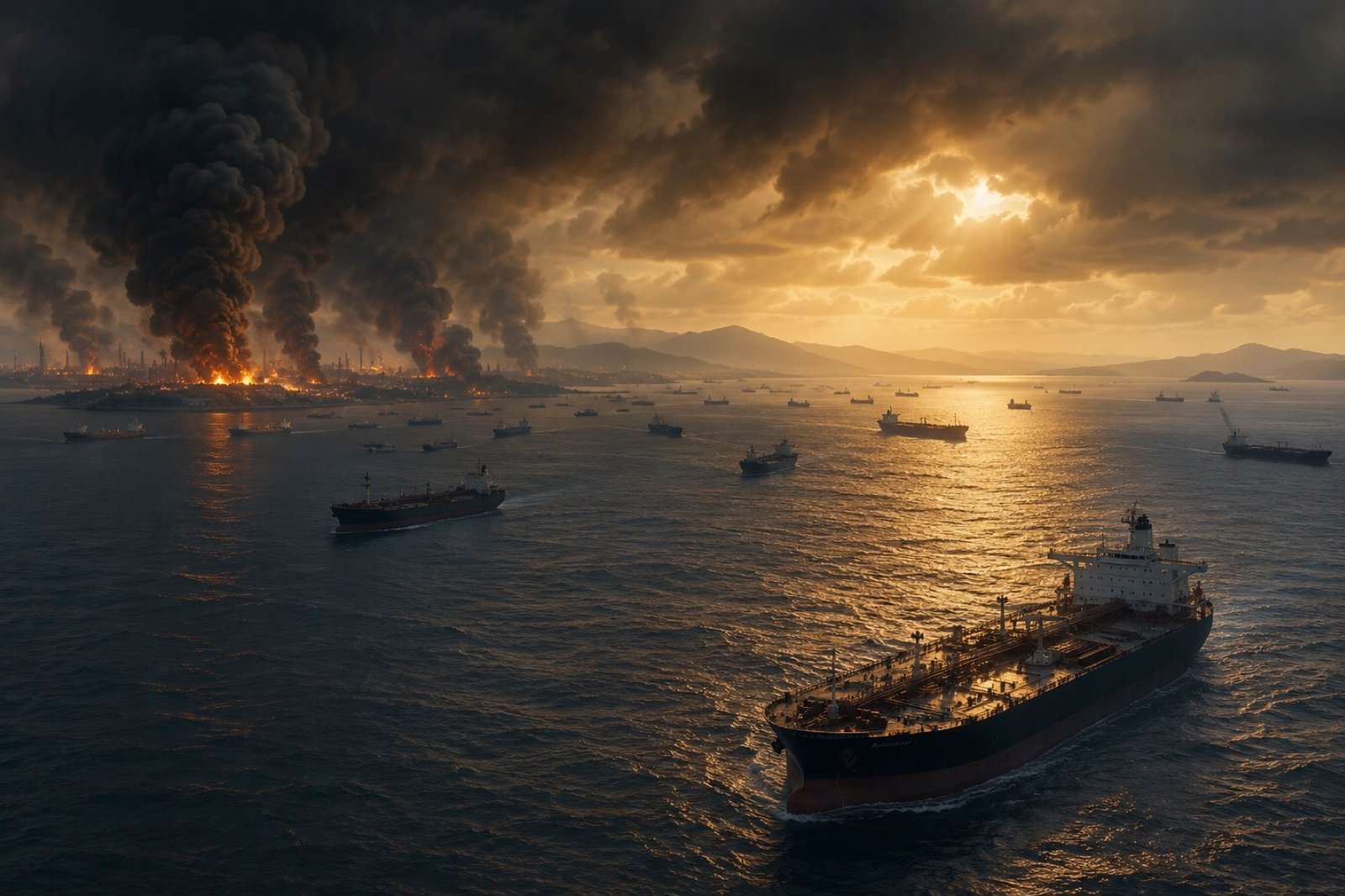
Oil prices jumped more than $1 a barrel after the US attacked an Iranian island in the Strait of Hormuz and drew retaliation from Tehran. What is your most up-to-date and in-depth assessment?
Economics-100, Chief Economist:
Executive Summary
My base case is that this is more important than the initial $1–$2 oil move suggests, but it is not yet an oil-supply shock. The market is repricing the probability of a future physical disruption in the Strait of Hormuz rather than pricing a major loss of barrels today.
As of August 31, 2026, Brent has moved above $90/bbl and WTI toward $85–86, after the U.S. struck two Iranian rocket launchers on Larak Island and Iran retaliated against U.S. bases in Jordan. Reuters reports that the attack was linked to concerns about Iranian preparations to deploy sea mines in Hormuz.
The critical distinction is:
The market is currently pricing the threat to the oil artery, not the destruction of the oil artery.
That makes the next few days unusually important.
1. What actually changed?
The U.S. operation on Larak Island is strategically significant because Larak sits directly inside the Hormuz system. Washington says the targets were launchers associated with the potential deployment of sea mines. Iran subsequently retaliated against U.S. facilities in Jordan.
That creates a dangerous feedback loop:
U.S. strikes → Iranian retaliation → U.S. counter-retaliation → greater Iranian incentive to threaten shipping → higher insurance/freight costs → fewer ships willing to transit → effective oil-supply reduction.
The important point is that Iran does not necessarily have to close Hormuz physically to create an oil shock.
If insurers, shipowners and crews decide that passage is too dangerous, commercial traffic can collapse even while Washington insists that the waterway remains formally open.
And that is already becoming visible: Reuters reports that shipping activity through Hormuz has fallen substantially, with only a handful of vessels passing during the weekend.
2. Why $90 oil is not yet the real story
The headline move—Brent rising roughly $2–$3—is actually fairly modest relative to the potential economic exposure.
The Strait of Hormuz normally handles around one-fifth of global oil flows, and it is also important for LNG.
So there are three possible stages:
| Stage | What happens | Approx. oil-market effect |
|---|---|---|
| 1. Threat premium | Military escalation but oil continues flowing | ~$85–95 |
| 2. Shipping disruption | Tankers avoid Hormuz; insurance/freight explode | ~$95–110+ |
| 3. Physical blockage | Sustained interruption of significant volumes | $120–150+ possible |
These are scenario ranges, not price targets.
The key variable isn’t how many missiles are fired. It is how many barrels actually fail to reach buyers.
That is why I would pay considerably more attention to tanker movements, war-risk insurance, freight rates, loading schedules and Asian refinery inventories than to the daily military headlines.
3. The most important strategic development: Hormuz has become the battlefield
This is where the episode differs from many previous Middle Eastern oil shocks.
In a conventional regional conflict, Iran can attack:
- U.S. military facilities
- Israeli interests
- Gulf infrastructure
- shipping
But Hormuz gives Tehran something much more powerful:
an asymmetric lever over the entire global economy.
Iran doesn’t need to defeat the U.S. Navy. It only needs to make commercial shipping sufficiently uncertain that private companies voluntarily reduce traffic.
That transforms the conflict from:
U.S.–Iran military confrontation
into:
U.S.–Iran confrontation + global insurance/transportation problem + energy-security crisis.
That is considerably harder for Washington to control.
4. Iran’s dilemma
Iran nevertheless has a major constraint.
A full closure of Hormuz would hurt Iran too.
Iran needs:
- oil export revenue
- access to Asian customers
- functioning ports
- imports
- foreign currency
- Chinese economic support
Therefore, Tehran’s optimal strategy is probably controlled disruption rather than permanent closure.
Think of it as:
“Make Hormuz dangerous enough to impose a cost, but not so dangerous that China and other major customers demand an end to the conflict.”
This is an important distinction.
Iran can threaten mines, attack selected vessels, conduct inspections, interfere with navigation or create uncertainty without announcing a formal blockade.
That produces a shadow blockade.
And economically, a shadow blockade can be nearly as consequential as a formal one.
5. Why the U.S. also has a difficult strategic problem
Washington’s immediate objective appears relatively narrow: prevent Iran from acquiring or deploying capabilities that threaten shipping through Hormuz.
But there is a paradox.
The more aggressively the U.S. attacks Iranian capabilities around Hormuz, the greater the incentive for Iran to demonstrate that it can actually disrupt Hormuz.
So military success can paradoxically generate an oil-market failure.
The U.S. therefore faces two objectives that can conflict:
- Destroy Iran’s ability to threaten the strait
- Keep the strait commercially usable
Those objectives aren’t identical.
If American strikes destroy launchers but trigger Iranian mining or retaliation against shipping, the tactical operation may succeed while the economic objective fails.
6. The Kharg Island issue is potentially much bigger—but don’t overreact yet
There is another important development today.
President Trump claimed that Iran’s Kharg Island, a major Iranian oil-export hub, was being destroyed. However, Reuters reports that there was no independent confirmation, Iran denied the claim, and the video accompanying Trump’s post was identified as AI-generated.
This is extremely important for market interpretation.
Do not price an alleged Kharg attack as fact.
Kharg is fundamentally different from Larak.
Larak = military/Hormuz-control significance.
Kharg = Iranian oil-export infrastructure.
If credible evidence emerged of sustained damage to Kharg’s export facilities, the oil-market implications would be dramatically larger.
That would move us from:
“Can Iran disrupt the world’s oil highway?”
toward:
“Iran’s own ability to export oil is being destroyed.”
That is a much more direct supply shock.
7. Historical comparison
There are useful historical parallels—but none is perfect.
1973–74: Arab oil embargo
The lesson was that oil prices can respond disproportionately to relatively concentrated physical disruptions because inventories and spare capacity cannot immediately adjust.
1979–80: Iranian Revolution
This is probably the more relevant psychological comparison.
The market didn’t merely react to barrels physically lost; it reacted to uncertainty about future production and exports.
2019: Saudi Abqaiq attack
This is perhaps the best modern comparison for market mechanics.
A relatively concentrated physical attack temporarily removed a large amount of production capacity and produced a dramatic price reaction.
Today
The present situation is different because the vulnerable asset isn’t just production capacity.
It is the transportation chokepoint.
That’s arguably more dangerous.
A damaged oil field affects one producer.
A disrupted Hormuz affects multiple producers simultaneously.
8. The biggest overlooked variable: LNG
Oil gets the headlines, but natural gas could become the more politically explosive commodity.
Qatar is heavily dependent on the maritime route around Hormuz for LNG exports.
If tanker traffic through the strait becomes unreliable, Asian LNG buyers could suddenly compete for alternative cargoes.
That creates:
Hormuz disruption → LNG shortage → Asian gas prices ↑ → electricity costs ↑ → industrial costs ↑
This could transmit the conflict into inflation far beyond gasoline.
Europe could also be pulled into the shock because LNG is increasingly the marginal source of gas supply.
So the economic risk isn’t simply:
$90 → $100 oil.
It is:
oil + LNG + shipping + insurance + currencies + inflation expectations.
9. Who wins and who loses?
Major relative winners
U.S. shale producers
Higher oil prices improve economics for marginal U.S. production, although shale cannot instantly replace Hormuz volumes.
Non-Hormuz oil exporters
Canada, Brazil, Guyana, Norway and parts of Latin America gain relative bargaining power.
Russia
This is strategically interesting.
Higher oil prices improve Russian fiscal revenues, while Western attention and political bandwidth are diverted toward Iran.
But Russia also faces complications because sustained high prices encourage additional non-Russian supply and potentially accelerate alternative-energy investment.
China, strategically
China is simultaneously a loser from expensive oil and potentially a winner geopolitically.
Why?
Because the crisis increases Beijing’s importance as:
- Iran’s major economic partner
- a potential diplomatic intermediary
- a major Asian energy buyer
- an alternative financial channel
The U.S.–Iran conflict therefore potentially increases China’s diplomatic leverage in the Gulf.
Major losers
India
Highly exposed to imported crude and therefore vulnerable to both oil prices and freight/insurance costs.
Japan and South Korea
Highly dependent on imported energy and maritime supply chains.
Europe
Particularly vulnerable through LNG and inflation.
Emerging-market importers
Countries with weak currencies face a double shock:
oil ↑ + dollar ↑ = imported inflation accelerates.
10. The inflation/Fed problem is now back on the table
This is perhaps the most important macroeconomic consequence.
Suppose Brent moves:
$90 → $100 → $110
That doesn’t simply increase gasoline prices.
It can generate:
- higher transportation costs
- higher airline costs
- higher petrochemical costs
- higher plastics costs
- higher food logistics costs
- higher inflation expectations
- tighter financial conditions
That complicates the Federal Reserve’s policy.
The market could therefore get an unusual combination:
oil ↑
inflation expectations ↑
bond yields ↑
Fed easing expectations ↓
equities ↓
This is a very different environment from a normal geopolitical scare.
The August 31 market reaction already shows this connection: oil rose while expectations of tighter monetary policy were also increasing.
11. But here’s the counterargument
There is a very important reason not to extrapolate today’s oil price straight to $120.
The global oil system has buffers.
There are:
- inventories
- strategic reserves
- spare production capacity
- alternative export routes
- Venezuelan production potential
- U.S. production
- Canadian production
- Brazilian production
And the market has already spent months pricing the conflict.
That means some of the geopolitical premium is already embedded.
Indeed, Brent had recently fallen toward the high-$80s after hopes of reopening Hormuz and diplomatic progress. Today’s escalation reversed part of that optimism.
So the question isn’t:
“Is there a war?”
The market already knows there is a war.
The question is:
“Has the probability of a sustained physical interruption of oil flows materially increased?”
Today, the answer is yes.
But we don’t yet know by how much.
12. My probability framework
My approximate scenario distribution as of today:
🟢 45% — Escalation but no sustained physical blockade
Iran retaliates, the U.S. responds selectively, but both sides ultimately avoid destroying commercial traffic.
Brent: roughly $85–100.
This is currently my base case.
🟠 35% — Prolonged shipping disruption
Mines, attacks or insurance concerns cause substantial numbers of tankers to avoid Hormuz.
Brent: roughly $100–120.
This is the most important upside risk.
🔴 15% — Major sustained Hormuz disruption
Large-scale shipping interruption involving a meaningful portion of Gulf exports.
Brent: potentially $120–150+.
This would produce a genuinely global inflation shock.
⚫ 5% — Rapid de-escalation
Diplomacy resumes and shipping normalizes.
Brent: potentially back toward $75–85.
These probabilities are judgment calls, not statistical forecasts.
13. What would make me turn substantially more bullish on oil?
I would watch five indicators, in this order:
1. Tanker traffic
This is the single most important indicator.
If vessels continue transiting Hormuz, the geopolitical premium should eventually fade.
If traffic collapses, the situation changes immediately.
2. Evidence of actual mines
This is potentially the market’s “red line.”
A credible minefield is much more consequential than rhetoric.
3. Insurance rates
If war-risk insurance becomes prohibitively expensive, commercial shipping can disappear without a formal blockade.
4. Kharg export capacity
Verified destruction of Kharg would change the supply equation dramatically.
5. Saudi/UAE alternative capacity
If Gulf producers can reroute meaningful volumes through pipelines and alternative terminals, the economic impact of Hormuz disruption becomes smaller.
14. The strategic picture
The deepest issue here isn’t actually oil.
It is control over the architecture of global energy trade.
For decades, the United States has effectively underwritten the security of Gulf energy flows.
China, India, Japan, South Korea and Europe all benefit from that security.
But the geopolitical distribution of the benefits is asymmetric:
America pays part of the security cost → Asia receives a large portion of the energy benefit.
Iran’s strategy challenges that architecture.
If Tehran can demonstrate that it can impose enormous costs on global shipping without being defeated militarily, the Gulf’s geopolitical balance changes.
That would accelerate several existing trends:
China–Gulf relationships ↑
U.S. military burden ↑
Gulf diversification ↑
strategic petroleum stockpiling ↑
alternative pipelines ↑
non-dollar energy settlement experiments ↑
In other words, Hormuz is not merely an oil chokepoint; it is a geopolitical chokepoint.
15. My bottom line
I would not interpret today’s move as simply “war premium = oil +$2.”
The more consequential development is that the U.S. and Iran have once again brought military operations directly into the physical geography through which the world’s energy system operates.
The market is therefore moving from:
geopolitical risk
to
logistical risk.
That distinction matters enormously.
If Hormuz remains physically open, Brent can eventually retreat toward the $80s despite continued fighting.
If tanker traffic materially collapses, $100 Brent stops looking extreme.
If a sustained closure develops, today’s $90 price could eventually look remarkably cheap.
And there is one particularly important warning against headline-driven trading: do not treat claims about Kharg Island as confirmed facts yet. Reuters says the alleged attack has not been independently confirmed and the associated video was AI-generated.
My central judgment: the immediate oil reaction is rational, but the convexity of the risk has increased. There is considerably more downside asymmetry for the global economy if shipping deteriorates than there is upside for consumers if the situation simply stabilizes.
The next decisive signal will not be another presidential statement or missile launch.
It will be the number of commercial tankers actually willing and able to pass through Hormuz.
Economics-100, Chief Economist
Three Corporate