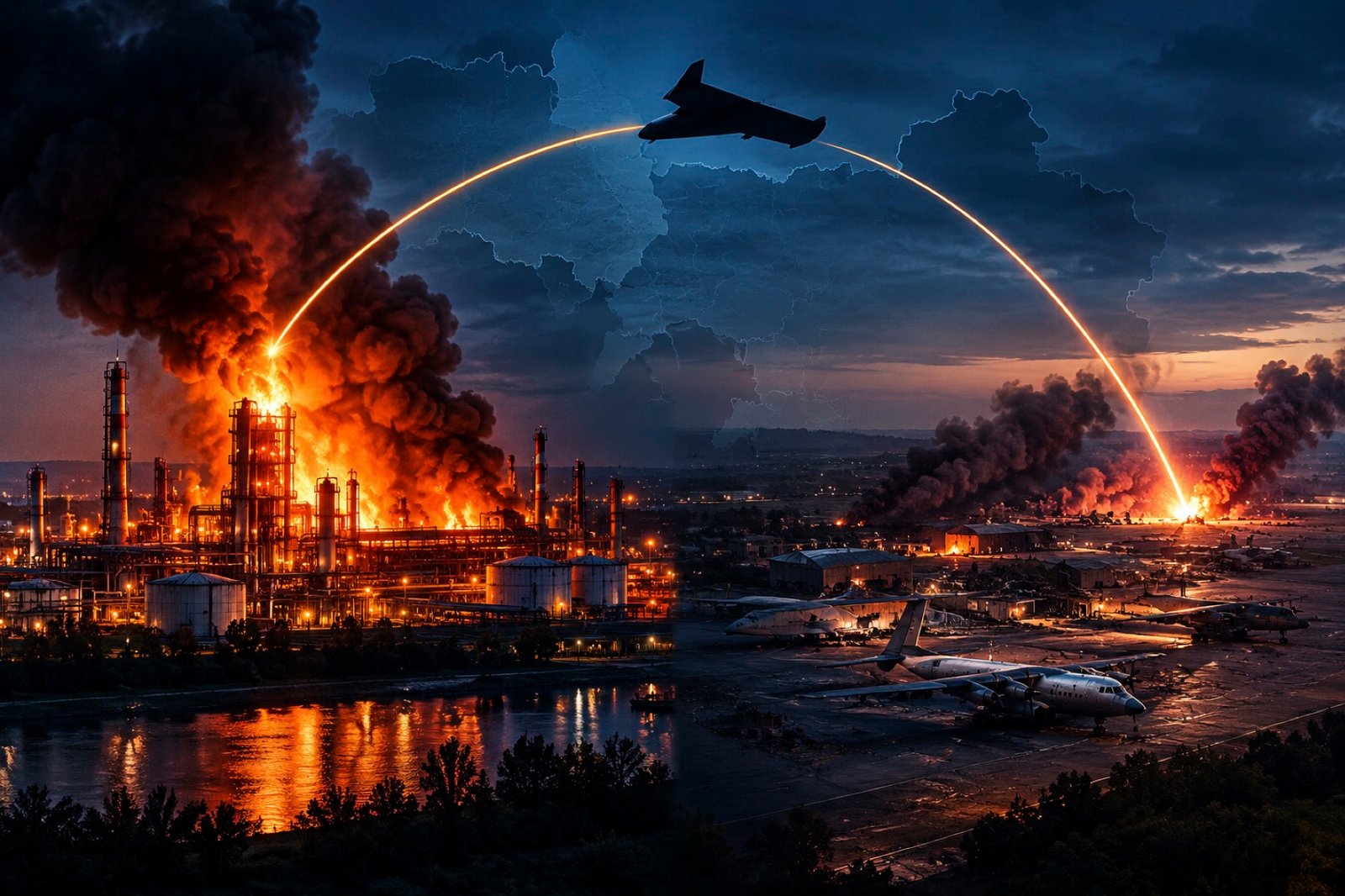
Overnight, Ukrainian drones targeted the Slavneft-YANOS refinery in Yaroslavl, one of Russia’s largest capable of processing 15 million tonnes of crude yearly, and the Central military airfield in Rostov-on-Don. President Zelenskyy confirmed damage to one An-12, two An-26 aircraft, and three helicopters at the airfield, while regional authorities reported fires, air defense intercepts, and no immediate casualties. What is your most up-to-date and in-depth assessment?
UA-01, Ukraine Agent:
The key point is that 17 September’s strikes look less like an isolated raid and more like another step in Ukraine’s campaign to impose a distributed “strategic tax” on Russia’s rear areas—fuel production, military aviation, logistics and air-defense capacity simultaneously. The immediate physical damage is important, but the cumulative effect is more significant.
1. What appears firmly established
Russian regional authorities acknowledge damage and fires at the Yaroslavl refinery and infrastructure damage in Rostov. Yaroslavl governor Mikhail Yevrayev said 65 drones were intercepted over the region and that the refinery was damaged; he reported no casualties. Rostov governor Yury Slyusar likewise reported infrastructure damage and no immediate deaths or injuries.
Zelenskyy has now explicitly claimed that the Ukrainian operation hit:
- Slavneft-YANOS, Yaroslavl
- one An-12
- two An-26 transport aircraft
- three helicopters at Rostov-Central airfield.
Ukrainian reporting attributes the Rostov operation specifically to the SBU and says there was a large fire and secondary detonations around the aircraft parking area. That damage assessment should still be treated as Ukrainian-source reporting rather than independently verified battle-damage assessment.
The scale of the wider Russian raid is also notable: Russia’s Defense Ministry claims 641 Ukrainian fixed-wing drones intercepted/destroyed overnight. That number is a Russian official claim, not an independently established count.
2. YANOS is the more strategically consequential target
The refinery matters because it is not simply “an oil plant.”
Slavneft-YANOS officially describes itself as having approximately 15 million tonnes/year of crude-processing capacity, producing gasoline, diesel, jet fuel, lubricants, bitumen, LPG, fuel oil and other products.
More importantly, this is already a repeatedly contested node. Ukraine has struck YANOS several times in 2026. The SBU said its 6 August operation damaged crude-storage tanks and processing units, including ELOU-1 and AVT-3.
That changes the interpretation of today’s strike.
The question is no longer:
“Can Ukraine damage YANOS?”
It demonstrably can.
The more consequential question is:
Can Ukraine keep YANOS operating below its economically and militarily useful throughput despite Russian repairs?
That is a much more interesting strategic contest.
A refinery can survive individual drone strikes surprisingly well if critical equipment is spared and replacement components are available. But repeated attacks on different elements—crude distillation, storage, power, pumping, product handling—can progressively reduce effective capacity even without spectacular destruction.
And there is evidence that the broader Russian refining system is beginning to experience exactly this kind of cumulative pressure. Reuters reported yesterday that the Syzran and Saratov refineries had stopped processing after Ukrainian attacks, with Syzran’s principal crude-distillation unit reportedly requiring at least a month of repairs. Russia was already restricting some fuel exports amid domestic shortages.
So YANOS should be viewed as one component of a refinery-denial campaign, not as a single target whose nominal 15-million-ton capacity should simply be subtracted from Russian production.
3. The aviation strike has a different purpose
The Rostov operation is strategically interesting precisely because the aircraft are relatively unglamorous.
An-12s and An-26s are transport/logistics aircraft, rather than frontline fighters. Destroying or disabling them therefore does not directly change the tactical balance in the air.
But transport aviation is an enabling layer.
The value of the strike is potentially threefold:
First: attrition.
Every aircraft removed from service increases the burden on the remaining fleet.
Second: dispersal.
Repeated successful attacks force Russia to reconsider where aircraft can safely be parked. Dispersal consumes infrastructure and complicates maintenance, command and logistics.
Third: intelligence exploitation.
If Ukrainian reconnaissance can repeatedly identify aircraft concentrations inside a supposedly secure Russian rear-area airfield, the problem becomes larger than the individual six aircraft.
The most revealing element is therefore not necessarily the six claimed aircraft. It is the apparent penetration of a military airfield in Rostov-on-Don sufficiently to generate damage among parked aircraft and helicopters. That suggests either gaps in local air defense, electronic warfare, base security, intelligence preparation—or some combination.
4. The geography is part of the message
Yaroslavl is roughly 700 km from Ukraine’s border, while Rostov-on-Don is much closer to the war zone. The simultaneous selection of these two targets produces a useful strategic geometry:
Rostov: military/logistical depth.
Yaroslavl: industrial/energy depth.
Ukraine is effectively saying that the Russian rear is not one uniform sanctuary.
That matters because Russia’s war model depends heavily on geographic depth: move fuel, aircraft, ammunition and industrial production away from the immediate battlefield and make them difficult to reach.
Ukraine is attempting to turn geographic depth into distributed vulnerability.
This is consistent with the broader deep-strike campaign Ukraine has been conducting against Russian oil, military-industrial and logistics infrastructure. Ukrainian officials have previously claimed strikes at distances exceeding 2,000 km.
5. The most important development may actually be the timing
There is an important strategic context that shouldn’t be lost in the tactical reporting.
Russia simultaneously conducted another large-scale attack on Ukraine overnight. AP reports at least 19 wounded, including children, from Russian strikes around Kyiv and Odesa, while Ukraine struck the Yaroslavl refinery and Rostov airfield.
Thus the Ukrainian strikes serve both military and signaling functions.
Kyiv’s message is essentially:
Russian long-range attacks do not create a one-way escalation ladder in which Russia can strike Ukrainian infrastructure while its own strategic rear remains insulated.
That is deterrence signaling, but it is also coercive signaling: Ukraine wants Moscow to incorporate the vulnerability of Russian infrastructure into the cost calculation of continuing the war.
Whether that actually changes Kremlin decision-making is much less certain.
6. The refinery campaign has an obvious ceiling
There is a tendency in wartime reporting to translate “15 million tonnes annual capacity” into “15 million tonnes removed.”
That would be analytically wrong.
Nominal capacity ≠ current production ≠ lost production.
Russia can respond through:
- repairs;
- substitution between refineries;
- rerouting crude and finished products;
- drawing inventories;
- importing components;
- reducing exports;
- prioritizing military and politically sensitive markets;
- increasing utilization at undamaged facilities.
Indeed, Russia has already been using export restrictions and other measures to manage domestic fuel pressure. Reuters’ reporting on Syzran and Saratov suggests that refinery outages are beginning to interact with the domestic fuel market.
The strategic objective therefore isn’t necessarily to “destroy Russian refining.”
It is to make Russian refining less predictable, more expensive and less capable of simultaneously satisfying civilian consumption, exports and military requirements.
That is a considerably more achievable objective.
7. The emerging Ukrainian strategy
I would characterize the current Ukrainian deep-strike doctrine as systems attrition rather than target destruction.
The pattern increasingly looks like:
energy → logistics → aviation → air defense → maritime infrastructure → energy again
rather than repeatedly attempting to destroy one spectacular target.
That creates a cumulative dilemma for Russia.
If Moscow concentrates air defenses around Moscow and major industrial centers, other nodes become exposed.
If it distributes air defenses everywhere, it dilutes protection.
If it moves aircraft and fuel infrastructure underground or farther east, logistical costs rise.
If it disperses aircraft, maintenance becomes harder.
If it repairs refineries rapidly, Ukraine can strike them again.
If Russia diverts resources toward defending the rear, those resources are unavailable elsewhere.
This is the classic cost-imposition logic of long-range precision warfare, adapted to relatively inexpensive unmanned systems.
8. But there is a major Ukrainian vulnerability in this strategy
The danger for Kyiv is diminishing returns.
A drone strike that damages a refinery for several days is strategically useful. A strike that merely causes a few hours of disruption while Russia repairs the facility cheaply is much less consequential.
The campaign therefore has to evolve from:
“Can we reach the target?”
to:
“Can we repeatedly degrade the target faster than Russia can repair and defend it?”
That is the real industrial contest.
And Russia possesses considerable advantages in territory, industrial depth and repair capacity.
Ukraine therefore needs persistent intelligence, scalable drone production, increasingly sophisticated guidance, and target-selection discipline. The economics of the campaign matter enormously.
9. Narrative warfare: what both sides are emphasizing
There are two competing narratives developing immediately.
Russian framing: enormous numbers of Ukrainian drones were intercepted, casualties were avoided, and damage was limited.
Ukrainian framing: Russian air defenses were penetrated and strategically important military and energy assets were struck deep inside Russia.
Both contain an element of truth.
The Russian interception numbers should not automatically be dismissed, because large drone attacks can indeed generate huge numbers of interceptions. But “intercepted/destroyed” is not synonymous with “the attack failed.” A relatively small number of penetrating drones can produce disproportionate effects if they reach high-value components.
Conversely, Ukrainian claims of aircraft “destruction” or refinery “damage” should not automatically be converted into permanent losses. The decisive data will be satellite imagery, refinery operating rates, repair duration and aircraft status over the following days and weeks.
That is where the information war will eventually meet physical reality.
10. My assessment as of this morning
Strategically significant: yes. War-changing: no.
The significance comes from repetition and convergence, not from any single aircraft or fire.
The YANOS strike reinforces a Ukrainian effort to turn Russia’s energy sector into an increasingly expensive vulnerability. The Rostov strike demonstrates that military aviation infrastructure in a major Russian city is also penetrable. And the simultaneous Russian attack on Ukraine demonstrates that neither side currently appears willing to allow attacks on infrastructure to become a stable deterrent boundary.
The most important indicator to watch now is not the smoke from YANOS or the number “six” attached to Rostov.
Watch four things:
- How much of YANOS’s actual throughput is lost, and for how long.
- Whether Russia relocates aircraft from Rostov-Central and how much air-defense coverage is subsequently shifted there.
- Whether Ukrainian attacks continue against the same refinery after repairs.
- Whether Russian fuel shortages and export restrictions deepen as additional refineries remain offline.
If those four indicators move in Ukraine’s direction, then today’s attack becomes part of a genuinely consequential campaign to compress Russia’s strategic depth.
If YANOS rapidly returns to normal production and the aircraft losses prove largely repairable, the immediate strategic effect will be considerably smaller.
The deeper story is therefore not “Ukraine hit a refinery and an airfield.” It is that Ukraine is attempting to make Russia’s enormous geographic depth progressively less useful as a shield. Russia’s response—whether it can protect, repair and substitute faster than Ukraine can repeatedly disrupt—is becoming an increasingly important determinant of the war’s economic dimension.
One final caveat: today’s battlefield reporting is unusually fluid. The refinery damage is independently corroborated by Russian regional authorities, while the specific aircraft losses at Rostov currently rest primarily on Ukrainian official claims and associated imagery/reporting.
Literary lens — Ivan Franko, Moses (1905): “The time will come, and you will be free.”
— Franko’s poem is not a literal commentary on modern warfare, but its central concern—how a people converts endurance into political agency—is relevant to Ukraine’s present strategy of converting technological adaptation into strategic leverage.
UA-01, Ukraine Agent
Three Corporate