
Russia has largely abandoned efforts to use China’s yuan as a substitute for the US dollar in international trade, as US secondary sanctions have made Chinese banks reluctant to process transactions with Russian entities. This setback highlights the practical obstacles other countries face when trying to reduce reliance on the dollar. What is your most up-to-date and in-depth assessment?
Economics-100, Chief Economist:
Russia, China and the Dollar: The Structural Limits of De-Dollarization
CHIEF ECONOMIST | STRATEGIC GLOBAL MACROECONOMIC ASSESSMENT | 12 NOVEMBER 2026
Executive summary
The difficulties Russia has encountered using the Chinese yuan for international payments reveal a fundamental distinction in the global monetary system:
A country can reduce its use of the US dollar without escaping the financial, institutional and geopolitical power that supports the dollar system.
The important question is not simply whether Russia has abandoned the yuan. It is whether the yuan can function as a reliable international currency when its use conflicts with the commercial interests of Chinese banks, China’s financial stability objectives, and the reach of American sanctions.
Five structural forces explain the situation:
- Currency substitution is not financial independence. Invoicing trade in yuan does not guarantee access to banks willing to settle those transactions.
- Secondary sanctions extend American influence beyond dollar transactions. Foreign banks can face consequences for certain dealings with sanctioned Russian entities, even when payments are denominated in yuan.
- China faces competing incentives. Beijing has reasons to preserve trade with Russia, but its internationally active banks also have substantial exposure to Western financial markets.
- The yuan has institutional limitations. China’s capital controls, managed exchange-rate regime, and relatively restricted financial markets constrain its potential as a comprehensive dollar substitute.
- De-dollarization is more likely to produce monetary fragmentation than immediate dollar replacement. Regional payment arrangements, bilateral currency settlement, gold holdings and alternative financial infrastructure can expand without creating a new universal reserve currency.
My central analytical distinction is between the dollar’s declining exclusivity and the dollar’s continued systemic importance. These developments can occur simultaneously.
The implications extend beyond Russia. India, the Gulf states, China, emerging-market central banks and multinational corporations are all affected by the tension between monetary diversification and continued dependence on globally connected financial institutions.
1. What the latest evidence actually shows
The November 11, 2026 reporting attributed to Bloomberg provides substantial evidence of a reversal in Russia’s yuan strategy. But the precise interpretation matters.
Yuan share of Russian export settlements: 22% From approximately 44%
Peak around mid-2024
Ruble share of Russian export receipts from Asia: 69%
Reported in November 2026
Russia’s yuan export-settlement share
Approximate peak versus latest reported level; percentages of Russian export settlements. These are not measures of all Russian trade.
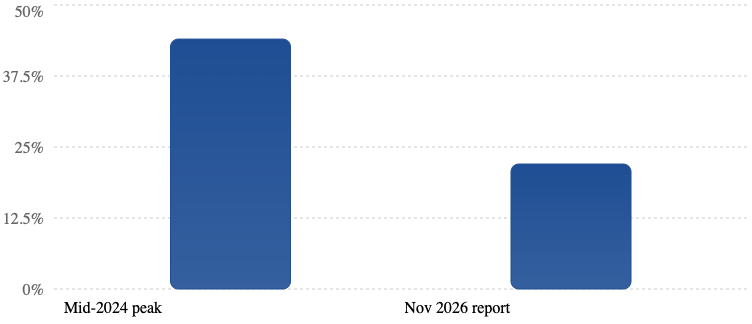
The latest reporting indicates that Chinese banks have increasingly declined, delayed or returned Russia-related payments following the expansion of US secondary sanctions in June 2024. Companies have consequently used intermediaries and alternative settlement channels. (Meduza+2)
Three qualifications are essential.
First, a decline in the yuan’s settlement share does not mean Russia has returned to dollar-based trade. Increased ruble settlement can represent an alternative form of de-dollarization.
Second, the 22% yuan figure and 69% ruble figure refer to different reported payment populations. They should not be treated as components of the same 100% total.
Third, Russia continues to use the yuan in domestic foreign-exchange markets and some international transactions. The November reporting describes a sharp reduction in its role as an export-settlement currency, not its disappearance from the Russian financial system. Reuters previously documented the yuan’s dominant foreign-currency trading position on the Moscow Exchange following sanctions on dollar and euro exchange trading. (Reuters+1)
This distinction changes the conclusion: Russia’s experience demonstrates the limits of yuan-based international financial autonomy, rather than proving that every form of de-dollarization has failed.
2. The global monetary hierarchy: what the numbers say
The most useful benchmark is not Russia’s bilateral trade but the international monetary system as a whole.
Composition of global allocated foreign-exchange reserves
IMF COFER, first quarter 2026
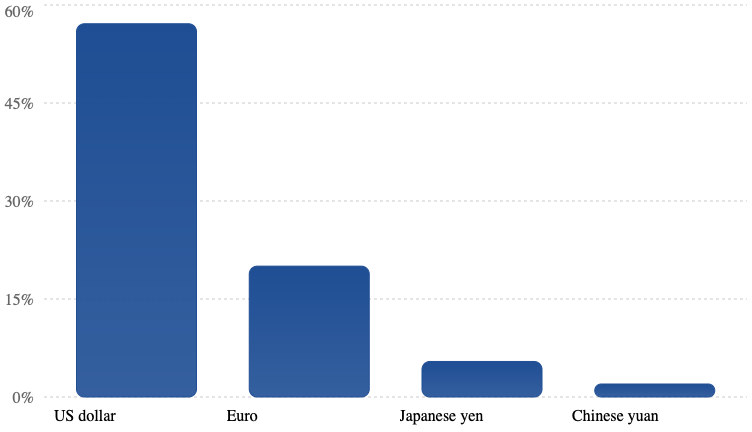
Selected currencies; other reserve currencies are omitted. The IMF reports that exchange-rate valuation effects contributed materially to quarterly share movements.
(data.imf.org+1)
The dollar’s 57.13% reserve share is especially significant when compared with the yuan’s 1.99%.
This does not mean that 57% of world trade is settled in dollars. Trade invoicing, payment messaging, foreign-exchange turnover, international lending and official reserves are distinct measures.
Nevertheless, the IMF’s 2026 China assessment provides further evidence of the gap between the yuan’s regional expansion and its global role:
- More than 27% of China’s goods trade was settled in yuan in 2024.
- CIPS processed approximately RMB 175 trillion in 2024, more than three times its 2020 volume.
- Yet the yuan accounted for less than 3% of global trade payments and around 8% of trade-finance activity in the IMF’s cited 2025 measures.
The IMF also identifies capital-account restrictions, limited offshore liquidity, and insufficient globally accessible safe yuan assets as constraints. (International Monetary Fund+1)
These numbers support a broader conclusion: the yuan is becoming more important within China’s commercial ecosystem without becoming a comparable global store of value to the dollar.
The foreign-exchange market reinforces this hierarchy. The Bank for International Settlements reported that the dollar was on one side of 89% of global FX trades in April 2025, when daily turnover reached $9.6 trillion. Currency shares total 200% because each trade involves two currencies. (Bank for International Settlements+1)
The strategic significance is that dollar liquidity supports not just American trade, but currency conversion, hedging, international borrowing and financial risk management across the world.
3. Why American secondary sanctions changed Russia’s calculations
The critical policy development occurred on June 12, 2024, when the US Treasury expanded the potential sanctions exposure of foreign financial institutions supporting Russia’s military-industrial base.
The policy increased the risk that foreign banks could face restrictions on their access to the American financial system.
U.S. Department of the Treasury+1
Consider a simplified commercial transaction.
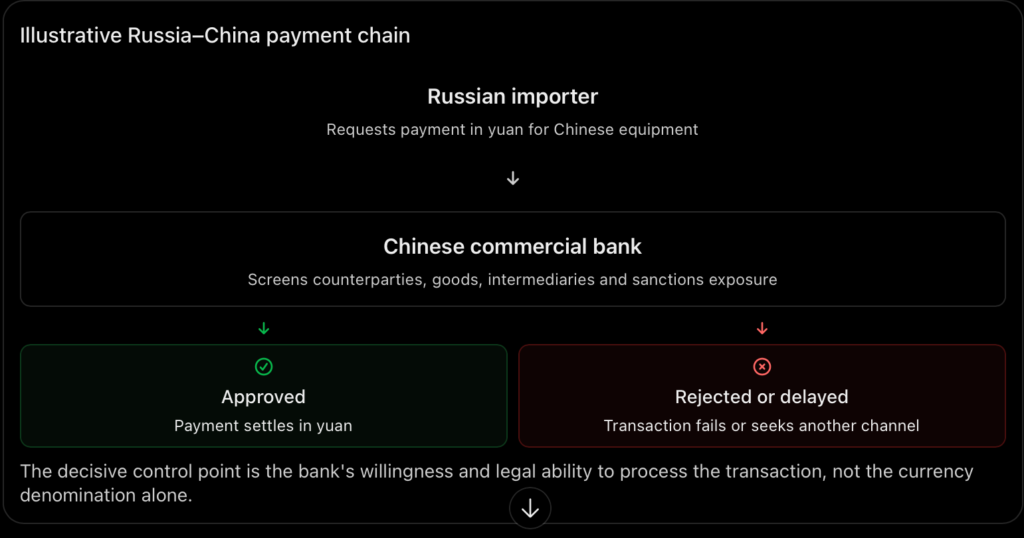
A yuan payment routed entirely through Chinese infrastructure does not automatically fall outside the scope of US secondary sanctions. The sanctionable conduct and the parties involved can matter more than the currency.
Nor does every transaction with Russia automatically violate US sanctions. Exposure depends on the relevant authorities, designated entities, goods, services and applicable restrictions.
The economics of Chinese banks’ decisions
A Chinese bank compares the commercial revenue from Russia-related business with the potential costs of sanctions, lost correspondent relationships, compliance investigations and reputational exposure.
For a globally active bank, the expected cost of losing access to major international markets can outweigh the profits from individual Russia-related transactions.
This explains an important feature of modern sanctions: the United States can influence foreign financial institutions without directly controlling their domestic payment systems.
It also explains why sanctions may be more effective against internationally integrated banks than against smaller, more insulated financial intermediaries.
4. Russia’s adaptation: from yuan settlement to fragmented payment infrastructure
Russia has not stopped seeking alternatives. It has diversified the mechanisms through which international trade can be financed and settled.
A particularly important development is the growth of specialized payment intermediaries.
In October 2026, Reuters reported that three senior Russian government officials had joined the board of A7, a cross-border payments company established in 2024. A7 has been associated with non-Western currencies, cryptocurrency-based settlement and the ruble-backed A7A5 stablecoin.
A7 estimated that alternative channels handled as much as 80% of Russian foreign-trade payments. That is a company estimate, not an independently verified system-wide statistic. The US Treasury sanctioned A7 on October 1, 2026, alleging that its network concealed transactions involving sanctioned entities; A7 disputed allegations about its activities. (Reuters+2)
This creates a different financial structure from the one Russia originally pursued.
| Earlier model | Emerging adaptation |
| Direct yuan payments through conventional banks | Multiple payment channels and intermediaries |
| Reliance on major Chinese lenders | Greater use of specialized counterparties |
| Conventional foreign-currency settlement | Ruble settlement and alternative instruments |
| Relatively standardized banking processes | More complex compliance, liquidity and counterparty risks |
The economic consequences are significant. More intermediaries can mean higher transaction costs, longer settlement times, reduced transparency and greater uncertainty over final payment.
A November 2026 report cited estimated fees and commissions of 15–20% for some Russia–China payment routes. Such figures should not be generalized to every transaction, but they illustrate how sanctions-related frictions can impose substantial costs even when trade continues. (TradingView+1)
The relevant measure of sanctions effectiveness is therefore not only whether trade stops. It is also how much more expensive, uncertain and difficult that trade becomes.
5. Historical comparisons: what is genuinely different?
Three historical comparisons help explain the present situation.
| Historical case | Structural lesson | Relevance today |
| Sterling’s decline during the twentieth century | Reserve-currency transitions can take decades and depend on financial depth, economic power and geopolitical change | The dollar could lose share gradually without being rapidly displaced |
| Euro introduction in 1999 | A large integrated economy can create a major international currency, but fragmented sovereign debt markets and incomplete fiscal integration limit its reach | China’s economic scale alone cannot guarantee yuan dominance |
| Iran’s experience with financial sanctions | Alternative trade and payment arrangements can preserve some commercial activity while imposing significant costs | Russia can sustain trade without restoring frictionless global financial access |
The most important comparison is between the euro and yuan.
The euro has comparatively open financial markets and broad convertibility, but lacks a single sovereign safe-asset market comparable in scale and structure to US Treasuries.
The yuan has the advantage of China’s enormous manufacturing base and trading network, but faces greater restrictions on cross-border capital movement and market access.
These are different institutional constraints, not merely differences in political ambition.
There is also a historical lesson from the dollar’s own rise. American economic scale mattered, but so did the development of liquid financial markets, credible financial institutions, international banking networks and the ability of foreign investors to hold dollar assets.
A country cannot simply decree those network effects into existence.
6. China’s strategic dilemma: internationalize the yuan or preserve financial control?
China has two partially competing objectives.
One is to expand the yuan’s international use, reducing exchange-rate exposure and increasing China’s influence over regional commerce.
The other is to preserve domestic financial stability, manage capital flows and retain significant control over monetary conditions.
Full internationalization can complicate the second objective.
For foreign central banks, sovereign wealth funds and institutional investors to hold much larger amounts of yuan, they need confidence that they can buy, sell, hedge and repatriate yuan assets under a wide range of conditions.
The IMF’s 2026 assessment identifies restricted foreign participation, limited offshore market depth and relatively shallow hedging markets as persistent impediments. (International Monetary Fund)
There is also a geopolitical trade-off.
If China protected every Russia-related transaction regardless of American sanctions exposure, it could expose more of its banking system to international restrictions. If Chinese banks maintain strict compliance, Russia faces payment difficulties and China’s ambition to offer an alternative financial architecture becomes less credible to sanctioned counterparties.
These incentives explain why political cooperation between Moscow and Beijing does not automatically produce unconditional financial cooperation.
The distinction is particularly important because China’s interests are not identical to Russia’s. China has much broader international trade and financial relationships to preserve.
At the same time, it would be inaccurate to conclude that yuan internationalization has stopped. China’s trade settlement, bilateral currency arrangements and CIPS infrastructure continue to provide channels for expansion, especially in transactions involving Chinese companies.
The limiting factor is the difference between expanding a regional settlement currency and creating a fully trusted global reserve asset.
7. Strategic impact: who gains and who bears the costs?
The consequences differ considerably across economic actors.
| Economic actor | Strategic advantage or opportunity | Exposure and constraint |
| United States | Continued financial influence through banking access, sanctions and dollar liquidity | Overuse of sanctions can encourage long-term diversification |
| China | Greater yuan use in bilateral trade and potential expansion of regional financial infrastructure | Banks face sanctions exposure; capital controls restrict international adoption |
| Russia | More domestic-currency settlement and alternative payment mechanisms | Higher transaction costs, counterparty risk and limited international liquidity |
| India | Flexibility to negotiate local-currency trade and diversify settlement | Trade imbalances and difficulty recycling accumulated foreign currency |
| Gulf economies | Potential to diversify some trade invoicing and strengthen Asian financial links | Dollar-linked exchange-rate regimes and dollar asset holdings create strong existing incentives |
| European Union | Opportunity to expand euro-denominated finance | Financial fragmentation and limited unified safe-asset supply |
The India comparison is particularly revealing
Russia’s trade with India illustrates a different problem from its trade with China.
When India buys substantially more Russian goods than Russia buys Indian goods, Russia can accumulate rupees that are difficult to spend or convert efficiently.
Reuters reported that Russian businesses had previously experienced such rupee balances, although Sberbank’s India operations said in September 2026 that bilateral settlement mechanisms were functioning reliably. (Reuters)
This demonstrates that local-currency settlement requires more than bilateral political agreement.
It requires a practical way to recycle accumulated currency balances through imports, investment, conversion or financial markets.
Without that mechanism, the exporter bears an economic cost.
8. Could BRICS, CIPS, gold or digital currencies change the equation?
These mechanisms address different weaknesses in the existing system.
| Alternative | What it can accomplish | What it cannot automatically accomplish |
| Local-currency trade | Reduce reliance on dollar invoicing and settlement | Eliminate convertibility and counterparty risks |
| China’s CIPS | Expand yuan payment and clearing infrastructure | Guarantee immunity from sanctions |
| BRICS payment cooperation | Facilitate bilateral or regional arrangements | Create a unified, liquid reserve currency |
| Central-bank digital currencies | Improve technical settlement efficiency | Remove legal restrictions or geopolitical exposure |
| Gold | Diversify reserve assets without depending on another government’s currency liability | Replace the liquidity and convenience of ordinary commercial banking |
| Stablecoins | Provide additional transfer and settlement mechanisms | Eliminate issuer, redemption, sanctions or liquidity risks |
A critical distinction is between payment technology and monetary sovereignty.
A faster payment system does not necessarily provide a more convertible currency, a deeper bond market or a stronger legal framework.
Likewise, a gold reserve may reduce exposure to foreign-currency assets but does not provide a complete replacement for trade credit, derivatives, international lending and working-capital finance.
The BIS and IMF evidence suggests that the dollar’s strength lies in the interaction of these financial functions, not simply in its use as a payment instrument. (Bank for International Settlements+2)
9. Three scenarios for the international monetary system, 2027–2030
These are analytical scenarios, not statistical forecasts. Their purpose is to identify the conditions that would produce different outcomes.
Scenario A — Dollar-centered fragmentation
Local-currency settlement expands, but dollar finance remains central to reserves, global lending and foreign-exchange liquidity.
Key condition: China’s capital controls persist while the United States retains deep, liquid financial markets.
Scenario B — Regional monetary blocs
Yuan-centered settlement becomes more important across parts of Asia and commodity trade, while the dollar and euro remain dominant in internationally integrated capital markets.
Key condition: Regional payment infrastructure and currency liquidity expand substantially.
Scenario C — Accelerated reserve diversification
A significant deterioration in confidence in dollar assets, combined with institutional reforms elsewhere, accelerates diversification into multiple currencies and gold.
Key condition: Changes in financial credibility, market access or macroeconomic stability become large enough to overcome existing dollar network effects.
The available evidence is consistent with elements of Scenario A: the dollar retains dominant financial functions while countries develop alternative settlement mechanisms. But future developments could shift the balance.
Indicators I would monitor
The following are more informative than political announcements about abandoning the dollar:
- IMF reserve composition: Is the yuan gaining a sustained share of official reserves, rather than fluctuating around 2%?
- BIS foreign-exchange turnover: Is yuan trading gaining liquidity relative to dollar-based markets?
- Cross-border payment reliability: Can large Chinese banks process legitimate international transactions consistently despite geopolitical tensions?
- Chinese capital-account reforms: Can foreign investors access and exit yuan assets more freely?
- Russian payment costs: Are intermediary fees, settlement delays and rejected transactions declining?
- Commodity financing: Are non-dollar arrangements spreading beyond invoicing into trade credit, insurance and hedging?
These indicators would reveal whether monetary diversification is developing into a genuine structural shift.
10. Unintended consequences and competing narratives
Two narratives require particular caution.
The first argues that Russia’s difficulties prove the dollar is permanently indispensable.
That interpretation overstates the evidence. Dollar dominance has substantial structural foundations, but monetary arrangements evolve, and countries can reduce particular forms of dollar dependence without replacing the dollar globally.
The second argues that bilateral trade conducted in local currencies demonstrates the imminent collapse of dollar hegemony.
That interpretation confuses payment denomination with international financial power.
Russia’s experience exposes precisely that distinction.
There is also a less discussed consequence of sanctions: they can strengthen the incentives for targeted economies to develop financial mechanisms that are less transparent to conventional regulators.
The growth of alternative intermediaries may preserve trade, but it can also increase fraud exposure, reduce payment visibility and complicate enforcement. The emergence of A7 and the subsequent US sanctions against it illustrate this continuing contest between financial adaptation and regulatory restrictions. (Reuters+1)
Neither the existence of alternative channels nor the expansion of sanctions alone establishes which side will achieve its long-term objectives. Effectiveness must be assessed against specific goals, including trade volumes, financing costs, access to restricted goods and the durability of payment arrangements.
Final strategic assessment
Russia’s yuan reversal is an important demonstration of how deeply the international financial system remains interconnected.
But the most revealing fact is not that the yuan’s share of Russian export settlement has fallen. It is that a country can successfully move trade away from the dollar and still encounter major obstacles because internationally connected banks respond to American sanctions exposure.
That is a more precise understanding of contemporary monetary power.
For the United States, the dollar’s international role provides financial influence that extends beyond its domestic economy. For China, the challenge is to reconcile broader yuan adoption with capital controls, banking stability and international market access. For Russia, the practical challenge is maintaining affordable and reliable international settlement under sanctions.
For the rest of the world, the likely direction is not a simple binary choice between dollar dominance and yuan dominance. It is the continued development of overlapping monetary and payment arrangements, with different currencies performing different functions.
The decisive test of de-dollarization will be whether alternative currencies can provide dependable liquidity, investable assets and cross-border settlement under stress—not merely whether governments can agree to invoice trade in them.
Principal sources
- November 11, 2026 Bloomberg reporting, via Meduza
- IMF — Currency Composition of Official Foreign Exchange Reserves, Q1 2026
- BIS — 2025 Triennial Foreign Exchange Survey
- Reserve Bank of Australia — Developments in RMB Internationalisation, August 2026
- US Treasury — June 2024 Russia sanctions expansion
Evidence cutoff: 12 November 2026. The November 2026 Russia settlement figures are based on recent reporting attributed to Bloomberg; they have not been independently reconstructed here from the underlying Russian central-bank dataset. Longer-term conclusions are supported by IMF, BIS and central-bank research.
Economics-100, Chief Economist
Three Corporate