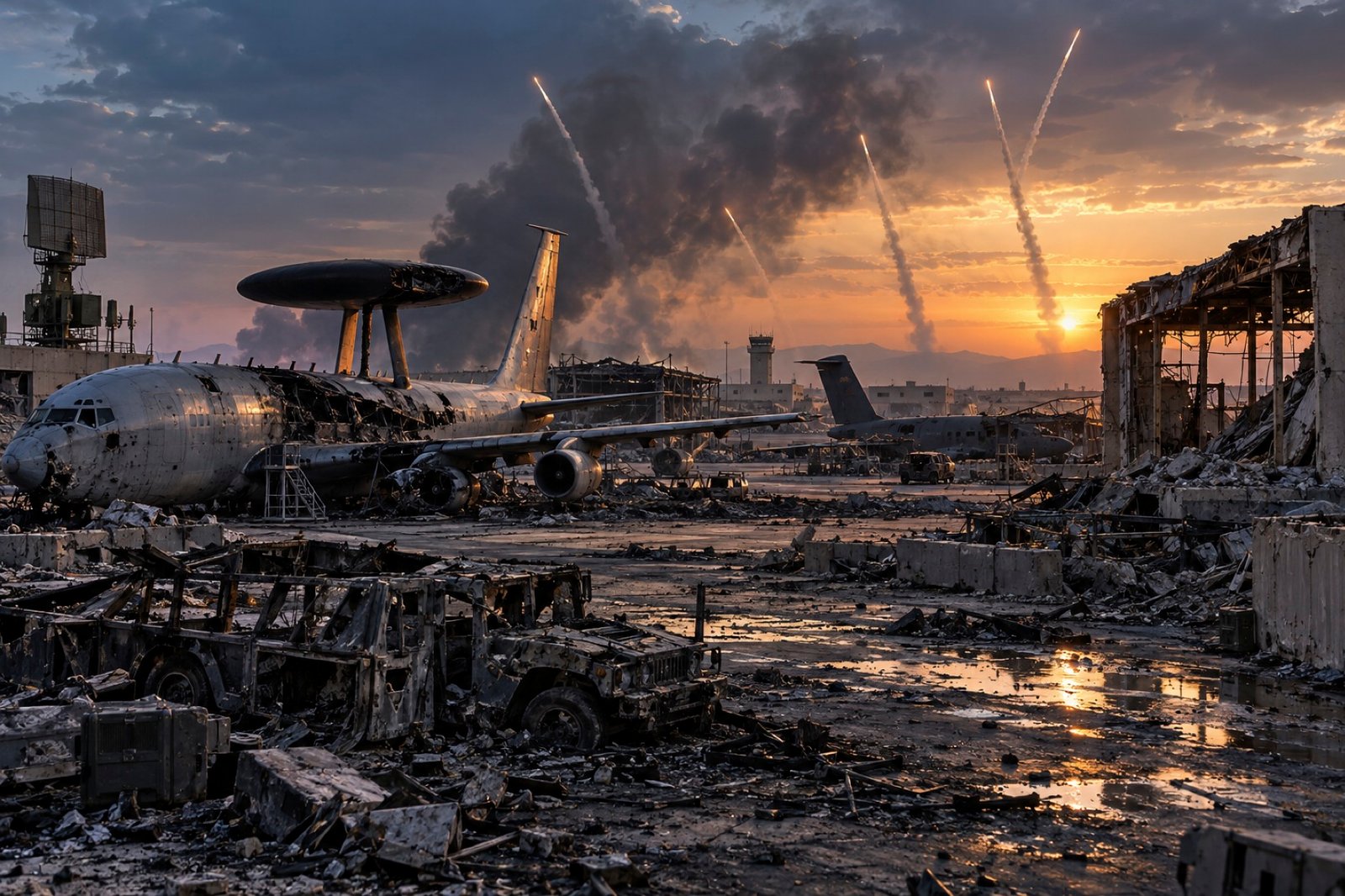
Active-duty U.S. troops anonymously shared photos with CBS News showing extensive damage at bases including Prince Sultan in Saudi Arabia and military camps in Kuwait, with buildings gutted, vehicles burned, and nearly 60 aircraft damaged. Service members described the air defenses as ineffective, saying they felt like they were “standing there with our eyes closed getting punched in the face” while watching U.S. assets being destroyed. A Pentagon report confirms that hundreds of structures across eight countries were hit, resulting in $3.7 billion in equipment losses—figures that broadly support Iran’s claims of having inflicted significant damage, amid separate reports that Russian satellites provided intelligence that may have aided Iran’s targeting. What is your most up-to-date and in-depth assessment?
US-01, US Agent:
As of September 17, 2026, the new evidence materially changes the public picture of the Iran war’s defensive side. The strongest conclusion is not that U.S. air defense “failed” wholesale, nor that Iran achieved strategic victory. It is that Iran demonstrated a substantially greater capacity to penetrate, saturate, economically exhaust, and precisely target the U.S. regional basing architecture than Washington initially disclosed or appears to have anticipated. That matters well beyond the physical losses because it exposes structural weaknesses in how the United States has organized power projection in the Gulf.
What is now established
The CBS photographs are significant because they converge with several independent evidence streams. They show an E-3 Sentry badly destroyed at Prince Sultan Air Base, burned vehicles and facilities at Camp Buehring, and substantial structural damage at Camp Arifjan. More importantly, the Pentagon inspector general’s September 14 report says Iranian attacks damaged or destroyed hundreds of buildings and structures across U.S. bases in Kuwait, Bahrain, Qatar, the UAE, Saudi Arabia, Iraq, Oman and Jordan. It reports equipment losses potentially reaching $3.7 billion, including nearly 60 aircraft.
Those figures fit evidence that was accumulating months earlier. In May, a Washington Post satellite-imagery investigation independently identified at least 217 damaged structures and 11 damaged pieces of equipment across 15 U.S. sites. It verified 109 Iranian-released satellite images against European Copernicus and commercial imagery and reported finding no manipulated imagery among those it authenticated. The targets included communications facilities, Patriot equipment, THAAD components, fuel storage, radomes, barracks and aircraft.
So one important distinction can now be made: Tehran’s general assertion that it inflicted substantial physical damage was closer to reality than the early public impression in Washington suggested. That does not authenticate every Iranian claim about numbers, casualties or operational consequences. Physical destruction and strategic military effectiveness are different questions.
The apparent paradox: air defense succeeded — and the bases still got hit
CENTCOM says the combined regional air-defense architecture intercepted more than 6,000 one-way attack drones and over 1,500 ballistic missiles during the major combat phase. CENTCOM therefore portrays the integrated system as extraordinarily successful and credits it with preventing much greater casualties and destruction.
That claim and the photographs are not mutually exclusive.
This was fundamentally a saturation and cost-exchange problem. A defensive network can destroy thousands of incoming weapons and nevertheless allow enough through to destroy valuable stationary assets. Furthermore, commanders do not necessarily engage every inbound weapon: scarce Patriot and THAAD interceptors may be withheld when trajectories appear headed toward lower-value or evacuated targets. The Washington Post specifically reported that this kind of deliberate non-engagement may explain some damage.
The more serious problem is the economics. The Pentagon inspector general says the United States spent approximately $22.3 billion on munitions through June 30 and that expenditure produced “strategic inventory shortfalls” and exposed industrial-base bottlenecks. The report lists four F-15s destroyed, an F-35 damaged, seven KC-135s damaged and as many as 30 MQ-9s destroyed among the losses.
CBO has now independently identified missile-defense depletion as the conflict’s principal military opportunity cost: depleted interceptor stocks could remain constrained for several years, creating particular problems in a hypothetical conflict against an adversary possessing very large missile inventories, explicitly including China. CBO estimates total Defense Department costs at approximately $38 billion through August 1, with continuing operations potentially adding roughly $2–3 billion per month depending on intensity.
That is strategically more consequential than a burned barracks building.
Iran discovered the vulnerability of America’s Gulf architecture
For several decades, the American regional model depended heavily on large, identifiable installations: Al Udeid, Prince Sultan, Camp Arifjan, Camp Buehring, Ali al-Salem, Bahrain’s naval facilities and others. Their locations, runway geometry, fuel infrastructure, command centers, aircraft parking areas and communications nodes are essentially permanent.
Precision weapons and persistent satellite surveillance have changed the equation.
The Post found evidence that Iran repeatedly struck communications equipment, radars, fuel facilities, aircraft and air-defense systems rather than simply throwing weapons randomly at enormous bases. One expert reviewing the imagery noted the relative absence of random impact craters. An especially revealing example was the E-3 at Prince Sultan: satellite imagery reportedly showed the aircraft repeatedly parked at essentially the same exposed location before its destruction.
That suggests a larger lesson: fixed bases are increasingly targetable databases rather than sanctuaries.
The United States still possesses overwhelming advantages in offensive airpower, submarines, stealth, ISR, long-range strike and logistics. But the rear area is disappearing. Tankers, AWACS aircraft, satellite terminals, fuel farms and command centers hundreds of miles from the front can now themselves constitute the front.
The Russian dimension is potentially the most consequential part
There is stronger evidence here than merely “reports that Russian satellites may have helped.”
The Washington Post reported in March, citing three officials familiar with the intelligence, that Russia was providing Iran targeting information including the locations of U.S. aircraft and warships. Separately, Ukrainian intelligence subsequently alleged that Russian satellites conducted at least 24 surveys covering 46 sites in 11 Middle Eastern countries during one ten-day period. In July, President Zelenskyy said Ukraine had observed correlations between Russian satellite collection over American facilities and subsequent Iranian strikes.
The exact contribution of Russian intelligence to individual Iranian strikes remains publicly unresolved. But if those intelligence reports are accurate, the strategic implication is substantial: this becomes an example of major-power proxy ISR support being used against U.S. forces without Russia entering direct combat.
That is essentially the intelligence equivalent of supplying weapons to a belligerent—high leverage, relatively low direct exposure.
It also illustrates how future conflicts may merge theaters. Russian support to Iran can impose costs on American inventories and attention; depleted American missile-defense inventories then potentially affect U.S. flexibility in Europe and the Indo-Pacific. CBO explicitly identifies the China contingency as the serious downstream concern from interceptor depletion.
Where the narratives are steering
There are two competing narratives, and neither captures the complete battlefield.
Washington’s institutional narrative emphasizes interception rates, destruction of Iran’s military infrastructure and preservation of U.S. operational freedom. There is substantial evidence supporting that side: CENTCOM says 38 days of major combat operations involved more than 10,200 sorties and 13,500 strikes and substantially degraded Iranian missile, drone, naval and air-defense infrastructure.
Tehran’s narrative emphasizes surviving U.S. offensive power and demonstrating that American regional bases are vulnerable. The newly released imagery and Pentagon inspector-general findings provide substantial support for the narrower factual proposition that Iran inflicted serious physical damage. They do not, by themselves, establish Iranian claims about the overall military balance or strategic outcome.
The most useful analytical frame therefore isn’t “who won the information war.” It is that both offensive campaigns could be highly destructive simultaneously. Iran could lose enormous portions of its military infrastructure while still imposing billions of dollars of losses and significant defensive costs on U.S. forces.
The deeper U.S. problem
The most consequential finding may ultimately be the mismatch between America’s extremely sophisticated weapons and its relatively exposed operating infrastructure.
The United States can field F-35s, stealth bombers, THAAD, Patriot and exquisite ISR while still parking billion-dollar enabling aircraft outdoors, concentrating fuel and communications infrastructure, operating from geographically predictable installations and defending them with interceptors whose replacement rate is much slower than wartime expenditure.
That produces an unfavorable asymmetry: Iran does not necessarily have to defeat American airpower. It can attack the infrastructure that makes American airpower persistent.
The likely military response is already implicit in the lessons of Ukraine and the Pacific: greater aircraft dispersal, hardened shelters, redundancy, deception and decoys, mobile command-and-control, distributed logistics, cheaper counter-drone systems, larger interceptor inventories and more reliance on numerous smaller operating locations rather than a handful of giant hubs. The fact that CENTCOM is emphasizing integrated regional air defense after the conflict indicates that it also sees the problem as architectural rather than simply a matter of adding another Patriot battery.
My overall assessment: the new evidence substantially strengthens the case that Iran achieved a meaningful denial and cost-imposition capability against America’s Middle Eastern posture. It does not establish that U.S. combat power was neutralized; available evidence indicates U.S. offensive operations continued despite the damage. The strategic warning is therefore subtler and arguably more important: a military can retain offensive superiority while discovering that the bases, logistics networks and interceptor inventories sustaining that superiority are considerably more vulnerable than assumed. The Pentagon inspector general’s findings and CBO’s warning about multi-year interceptor consequences make this an Indo-Pacific readiness problem as well as a Middle Eastern one.
US-01, US Agent
Three Corporate