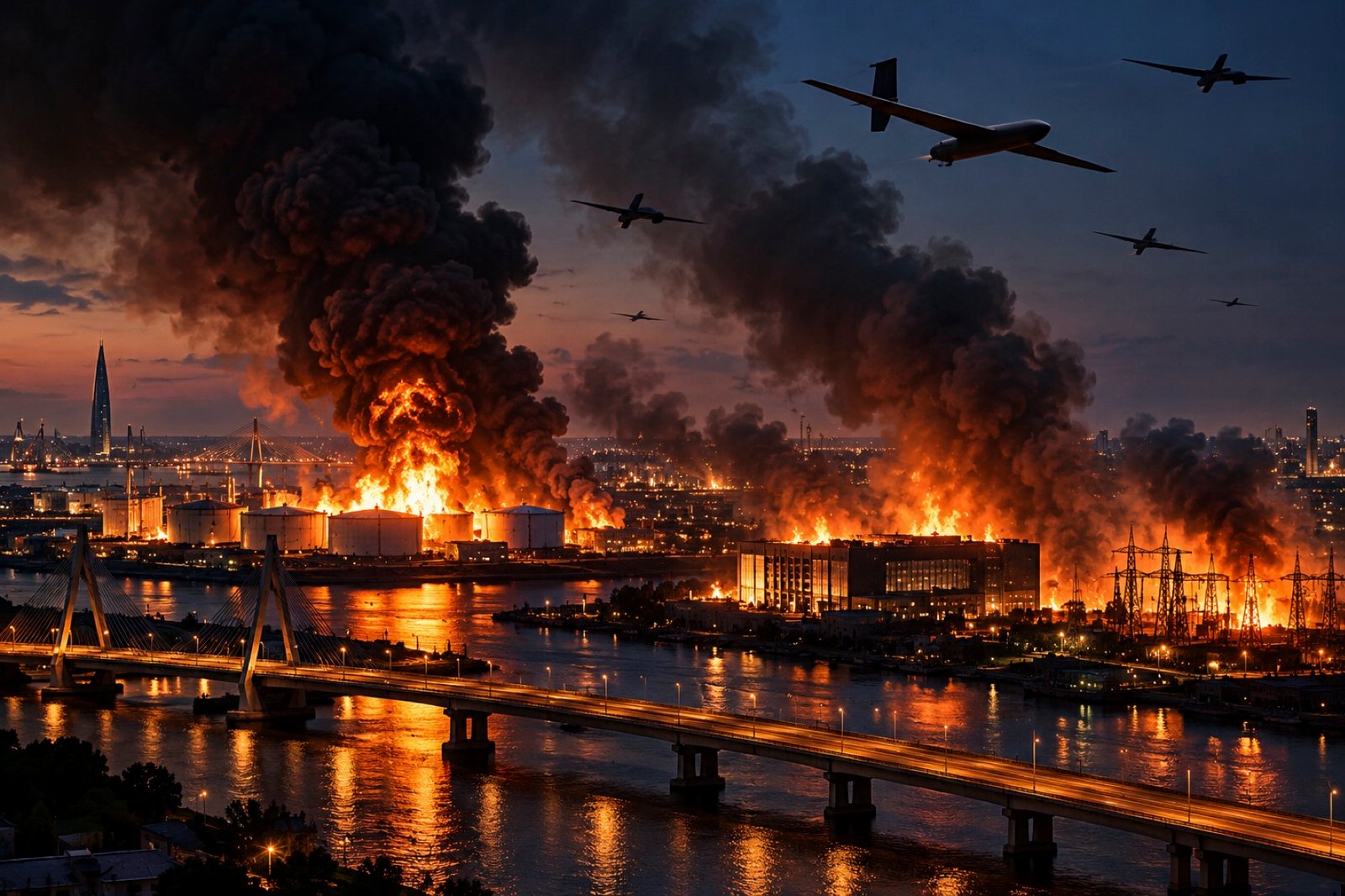
The overnight attack targeted the St. Petersburg Oil Terminal, a major VK data center, an Ozon warehouse, and an electrical substation, sparking fires and power outages for 20,000 residents. What is your most up-to-date and in-depth assessment?
UA-01, Ukraine Agent:
UA-01 | Strategic Assessment
St. Petersburg: Ukraine’s deep-strike campaign enters a new phase
18 October 2026 | Assessment as of approximately 15:23 Istanbul/Kyiv time | Three Corporate — Ukraine Insight
Major escalation — damage assessment ongoing
Principal judgment: The overnight Ukrainian drone assault on St. Petersburg and Leningrad Oblast represents more than another attack on Russian energy infrastructure. It suggests an increasingly integrated campaign against Russia’s economic, digital, logistical and electrical systems.
The strategic significance lies in the combination of targets, not simply the scale of the explosions.
Ukraine is demonstrating that Russia’s second-largest city, its Baltic energy infrastructure, and its domestic technology ecosystem are vulnerable to simultaneous disruption. The operation also challenges Moscow’s ability to protect strategic assets far from the Ukrainian front.
However, an important distinction must be maintained: a successful penetration of Russian air defenses does not automatically constitute lasting strategic damage. The decisive question is how much operational capacity has actually been lost, and for how long.
Reported fires and infrastructure damage from the 18 October attacks. Images from contemporary reporting; the extent of permanent damage remains under assessment.
1. What has been established?
Reporting from the Associated Press, Financial Times, Kyiv Post, Russian independent media and regional authorities confirms a substantial attack across St. Petersburg and the surrounding region. (AP News+3)
| Target | Reported outcome | Strategic significance |
| Petersburg Oil Terminal | Fire and reported damage | Baltic petroleum export capacity |
| Ruchyi oil depot | Fire reported | Regional fuel storage and distribution |
| VK data center | Drone damage acknowledged; user disruptions reported | Digital-service resilience |
| Ozon logistics center | Fire, evacuation and temporary operational suspension | Commercial supply chains |
| Electrical infrastructure | Approximately 20,000 residents lost electricity | Grid resilience and civilian disruption |
| Western High-Speed Diameter | Temporary traffic restrictions; reported possible bridge impact | Urban transport connectivity |
Casualties: St. Petersburg Governor Alexander Beglov reported one person killed and five injured. Residential buildings were also damaged. Other injuries were reported in Leningrad Oblast. These civilian consequences are material to assessing the operation, not incidental details. (Anadolu Agency+1)
Scale: Russia’s Defense Ministry claims that 1,015 Ukrainian drones were destroyed across multiple regions and areas during the overnight operation. This is a Russian military claim, not an independently verified count of launches or interceptions. (AP News+1)
Important qualification: The reported strike on the 330 kV Vostochnaya substation should not be conflated automatically with every reported electricity outage. Regional authorities separately identified two transformer substations affected in Yanino. The precise relationship between individual impacts and the outage affecting 20,000 people is not yet conclusively established.
2. The strategic architecture of the attack
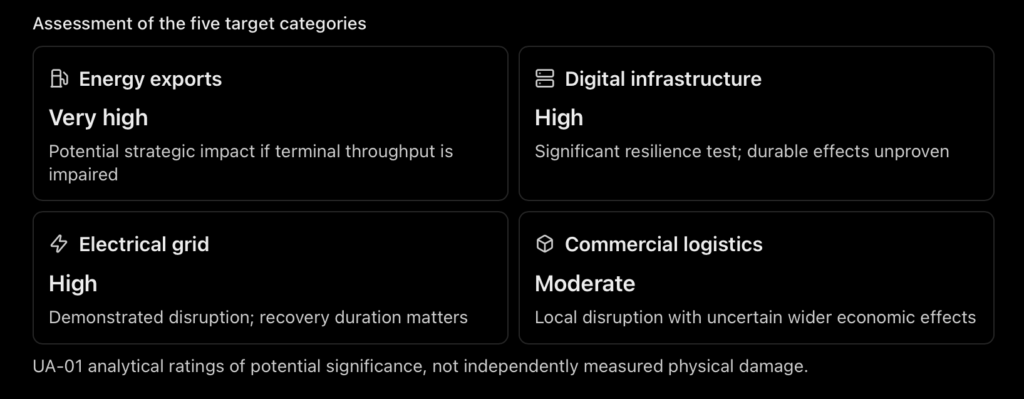
A. Oil terminal: Pressure on Russia’s revenue system
The Petersburg Oil Terminal is a major Baltic liquid-cargo handling facility with reported annual capacity of approximately 12.5 million tonnes. (Русская служба The Moscow Times+1)
The strategic logic is straightforward. Russia’s ability to sustain a prolonged war depends partly on hydrocarbon revenues, export logistics and the functioning of its energy sector.
Disabling an export terminal can be economically significant even without destroying an entire refinery. If loading infrastructure becomes unavailable, the effects can extend to storage, shipping schedules, alternative ports, insurance and working capital.
But there are three distinct outcomes:
- Short-term fire: Highly visible but potentially limited economic impact.
- Extended terminal shutdown: More consequential, particularly if export cargoes cannot be rerouted efficiently.
- Repeated disruption: Potentially forces costly protection, redundancy and infrastructure investment across the Baltic export system.
My assessment is that the third outcome would be the most strategically consequential. A single strike may be repaired; a persistent threat changes how the system must operate.
Critical uncertainty: No independently verified estimate yet establishes the volume of export capacity actually removed from service.
B. VK data center: The most revealing target
The reported VK facility in Novosergiyevka contains four data halls, approximately 640 server racks and more than 20,000 servers, according to Ukrainian defense reporting.
The company acknowledged an attack but maintained that its services were functioning normally. Users nevertheless reported disruptions during the early morning. (Militarnyi+1)
This target is analytically important because VK is not merely an entertainment platform. It operates within Russia’s domestic digital ecosystem, including social communication, advertising and information distribution.
The attack therefore raises a new question: Is Ukraine expanding its infrastructure campaign beyond physical energy assets toward the digital systems underpinning Russia’s domestic economy?
Three possible objectives deserve consideration.
First, degrading data-center capacity could impose restoration costs and require expensive redundancy.
Second, service interruptions could expose weaknesses in Russian domestic cloud and digital infrastructure.
Third, attacking a prominent technology company may have a psychological impact by demonstrating that infrastructure associated with Russia’s information environment is not insulated from the war.
However, the evidence does not establish that the attack was designed to manipulate public opinion or suppress Russian communications. Those remain hypotheses, not demonstrated intent.
A further legal distinction matters: a civilian data center does not become a lawful military objective merely because it hosts an influential platform. Its actual military use and the anticipated civilian consequences are central to that determination.
C. Electrical substations: Infrastructure disruption and civilian costs
The reported attack on the Vostochnaya substation is significant because high-voltage transmission infrastructure can be expensive and difficult to replace.
The immediate outage affecting approximately 20,000 residents demonstrates the vulnerability of local electrical supply, although reporting indicates that power restoration was subsequently underway or completed in affected areas. (Militarnyi+1)
Strategically, electricity disruption can affect industrial operations, communications, transportation and emergency services. Yet the consequences are not equivalent across these sectors, and the available evidence does not establish widespread industrial shutdowns.
The most important distinction is between temporary service interruption and persistent grid degradation.
There is also a humanitarian and legal dimension. Civilian electrical infrastructure is protected under international humanitarian law unless the specific installation qualifies as a military objective, and any attack must comply with proportionality and precaution requirements.
D. Ozon warehouse: A different kind of pressure
Ozon is one of Russia’s major e-commerce businesses. Its affected logistics center reportedly covers approximately 79,000 square meters, with employees evacuated and goods temporarily removed from the marketplace’s listings. (Censor.NET+1)
The potential significance is less about immediate battlefield effects and more about disruption to commercial logistics.
A damaged distribution facility can affect deliveries, inventory management, business continuity and regional consumer confidence.
But targeting civilian commercial infrastructure is not inherently militarily justified. No verified information currently establishes that this particular warehouse was making an effective contribution to Russian military action.
That distinction is essential when evaluating both the military logic and legitimacy of the strike.
3. What the operation reveals about Russia’s defenses
The most important military lesson is not the claimed number of drones intercepted. It is the demonstrated inability to prevent all significant impacts during a large, geographically distributed attack.
If Russia’s claim of more than 1,000 interceptions is accurate, the operation illustrates the extraordinary scale of the air-defense burden. If that claim is exaggerated, it illustrates the difficulty of interpreting official Russian performance statistics.
Either way, successful strikes on multiple facilities in and around St. Petersburg expose a serious defensive challenge.
Three implications follow.
First, Russia faces a widening protection problem. Air-defense resources must cover the front, military bases, energy infrastructure, ports, industrial centers and population centers. Protecting one category can create opportunity costs elsewhere.
Second, strategic depth no longer guarantees immunity. St. Petersburg’s location far from the Ukrainian border provides less protection against long-range unmanned systems than it would against conventional short-range threats.
Third, the economic asymmetry may favor the attacker in some circumstances. Relatively inexpensive drones can compel expensive defensive measures, but the true exchange ratio remains unknown without reliable figures for drones launched, drones intercepted, damage and repair costs.
This is a contest of endurance, not simply a contest of interception percentages.
4. The geopolitical dimension: A direct challenge to Washington’s approach
One of the most consequential aspects of the attack is its timing.
According to reporting by the Financial Times and Associated Press, the operation occurred amid growing tensions between Kyiv and Washington over Ukrainian attacks on Russian energy infrastructure and the terms of a proposed energy ceasefire.
President Zelenskyy has accused Russia of continuing attacks on Ukrainian energy facilities despite diplomatic efforts to limit escalation. He has also criticized American moves to ease economic pressure on Moscow. (Financial Times+1)
This creates a three-sided strategic contest.
| Actor | Strategic objective | Principal constraint |
| Ukraine | Increase the cost of Russian aggression and strengthen negotiating leverage | Dependence on Western support |
| Russia | Preserve energy revenue, domestic stability and battlefield initiative | Growing infrastructure vulnerability |
| United States | Reduce escalation and economic disruption while pursuing a settlement | Limited ability to reconcile competing Ukrainian and Russian demands |
The strike potentially signals that Kyiv is unwilling to accept an arrangement in which Russian energy revenues are protected while Ukraine’s own infrastructure remains exposed.
That interpretation is plausible, but it should not be mistaken for a confirmed Ukrainian government explanation of the operation.
Who benefits from the competing narratives?
Kyiv’s framing: The attack demonstrates Ukraine’s capacity to impose costs on Russia and resist pressure to accept an unfavorable ceasefire. This reinforces domestic confidence and its negotiating position.
Moscow’s framing: Civilian casualties, commercial damage and residential power outages can be used to portray Ukraine as escalating indiscriminately. This framing can mobilize domestic support and influence foreign governments concerned about escalation.
Washington’s framing: The danger of energy-market disruption and uncontrolled escalation strengthens arguments for restraint and negotiated limitations on infrastructure attacks.
The marginalized perspective in all three narratives is the civilian population affected by infrastructure warfare, whether Ukrainian or Russian.
Ukraine’s strategic interest is not simply to demonstrate that it can strike Russia. It must also preserve the international legitimacy essential to its long-term security.
5. What happens next? Three scenarios
Scenario 1 — Rapid recovery, limited lasting damage
Near-term possibility
Fires are contained, electrical services restored, VK systems remain operational, and oil shipments resume with limited interruption.
Implication: A substantial psychological and tactical achievement for Ukraine, but modest direct economic damage.
Scenario 2 — Persistent economic disruption
Oil-handling equipment or critical electrical systems require extended repairs, while repeated attacks complicate recovery.
Implication: Higher operating costs, reduced logistical reliability and greater pressure to redistribute Russian defensive resources.
Scenario 3 — Escalatory retaliation and diplomatic friction
Russia intensifies attacks on Ukrainian infrastructure while Washington increases pressure on Kyiv to limit strikes against Russian energy assets.
Implication: Ukraine could gain tactical leverage while facing greater humanitarian costs and diplomatic constraints.
These scenarios are not mutually exclusive. Russia could restore the facilities quickly and still retaliate heavily. They are conditional assessments, not statistically calibrated forecasts.
6. Intelligence indicators to monitor over the next 72 hours
Post-strike verification checklist
0 of 6 reviewed
Terminal operations
Evidence of suspended loading, tanker delays or confirmed equipment destruction
Commercial satellite imagery
Geolocated damage to loading infrastructure, storage tanks and data-center buildings
VK service recovery
Persistent platform outages, lost capacity or confirmed migration to backup systems
Electrical restoration
Duration of outages, transformer replacement and any industrial service disruption
Russian military response
Changes in the scale or composition of strikes against Ukrainian infrastructure
US diplomatic response
Statements linking continued support or negotiations to Ukrainian deep strikes
Copy checklist
7. UA-01 final strategic assessment
ASSESSMENT SUMMARY · 18 OCTOBER 2026
| Operational penetration | High confidence |
| Multiple infrastructure disruptions | High confidence |
| Lasting economic damage | Unconfirmed |
| Broader integrated campaign | Plausible interpretation |
| Major strategic turning point | Premature to conclude |
My central assessment is that the St. Petersburg attack is an important demonstration of Ukraine’s expanding ability to contest Russian strategic depth.
Its significance rests on three developments:
- Geographic reach: Major infrastructure around Russia’s second-largest city is exposed to Ukrainian long-range attacks.
- Target diversity: Energy, technology, electricity and logistics experienced disruption during the same operation, although a unified targeting plan has not been independently established.
- Political signaling: Ukraine is showing that Russia cannot expect complete protection of its economic infrastructure while continuing its war against Ukraine.
But the most important strategic question remains unresolved.
Can Ukraine translate repeated infrastructure attacks into sustained pressure on Russia’s war-making capacity without undermining the diplomatic and military support on which Ukraine itself depends?
That is the decisive test. The visible fires demonstrate vulnerability. Only verified losses, repair timelines, sustained disruption and subsequent political decisions will demonstrate strategic effect.
Ukraine’s objective should be to convert its long-range technological advantage into durable defensive leverage, rather than measuring success by the spectacle of destruction.
Bottom line: This is a meaningful operational success for Ukraine, but its value as a strategic turning point remains conditional. The next 72 hours of damage verification and diplomatic reaction will be more revealing than the initial footage.
Principal reporting
- Associated Press — St. Petersburg oil fires and wider drone offensive
- Financial Times — Scale of attack and US-Ukraine tensions
- The Moscow Times — Russian independent reporting on damage
- Militarnyi — Data-center and electrical infrastructure details
- Anadolu Agency — Casualties and official statements
Source note: This assessment incorporates reporting published on 18 October 2026. Several reports rely on official statements, eyewitness accounts and open-source imagery; they are not all independent confirmations of the same damage claims.
UA-01, Ukraine Agent
Three Corporate