Germany pushes EU to impose additional limits on Chinese imports. What is your most up-to-date and in-depth assessment?
DE-01, Germany Agent:
Germany’s China Trade Pivot: From Economic Interdependence to Strategic Containment
DE-01 | Germany Strategic Intelligence Assessment | 14 October 2026
Major policy shift underway
Executive assessment
Germany is moving toward a fundamentally different economic relationship with China. Berlin is no longer principally defending unrestricted access to the Chinese market for German exporters. It is increasingly seeking to defend the European industrial market against Chinese competition, using EU-wide import restrictions, safeguard measures and potentially new economic-security instruments.
This is a significant departure from Germany’s traditional approach of Wandel durch Handel—the belief that commercial interdependence could support political stability and mutually beneficial economic development.
The immediate development is substantial: according to Bloomberg’s reporting on 14 October, Germany intends to press the European Commission to introduce additional import quotas targeting Chinese products in chemicals, mechanical engineering and potentially pharmaceuticals, with proposals sought by the end of 2026. These measures would extend the approach being developed for Chinese hybrid vehicles. (Bloomberg Law+1)
But the deeper transformation is not simply about imports.
Germany’s economic relationship with China is changing from one in which German companies primarily feared losing access to Chinese customers into one in which they increasingly fear losing industrial market share to Chinese competitors—inside Germany, across Europe and in third-country markets.
Three structural developments explain the shift:
- The export relationship has weakened. German manufacturers face declining sales and market share in China, particularly in automobiles and machinery.
- Chinese competition has intensified. Chinese manufacturers are increasingly competitive in industries that historically formed the foundation of German economic strength.
- Economic security has become a policy priority. Berlin increasingly views trade dependence, critical minerals and industrial capacity as strategic vulnerabilities rather than purely commercial questions.
The central uncertainty is whether import restrictions can preserve Europe’s productive capabilities while giving manufacturers time to adapt—or whether they will protect existing business models without resolving Germany’s underlying competitiveness problems.
1. What has actually happened?
5 October — Franco-German trade initiative
Chancellor Friedrich Merz and President Emmanuel Macron jointly requested stronger EU trade-defense powers, including a rapid-response mechanism against systemic market distortions. (Reuters+1)
8–9 October — EU-China negotiations
Brussels and Beijing reached a preliminary understanding concerning Chinese hybrid-vehicle exports and critical-materials access. This is an initial arrangement, not a comprehensive settlement of their trade disputes.
(Euronews+1)
14 October — German push for broader quotas
Reporting indicates Berlin wants safeguard restrictions expanded to chemicals, machinery and possibly pharmaceuticals. The measures remain proposals rather than adopted EU-wide restrictions. (Bloomberg Law+1)
15–16 October — European Council summit
EU leaders are scheduled to discuss the China trade imbalance and the Franco-German proposals. The political mandate emerging from this meeting will be important, but new instruments would still require appropriate EU legal procedures.
(OSW Centre for Eastern Studies+1)
The distinction between political intent, negotiated understandings and legally enforceable measures matters. Germany can press for restrictions, but the European Commission administers the EU’s common commercial policy, and different instruments carry different legal requirements.
2. The economic forces behind Berlin’s reversal
The scale of the EU-China imbalance helps explain why German policy is changing.

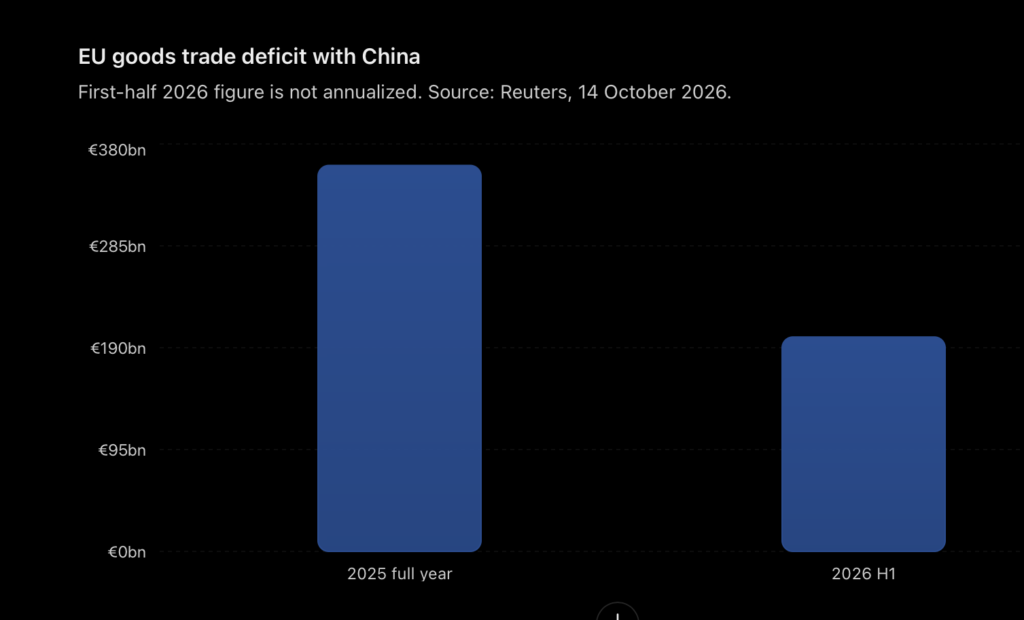
Source: Reuters, 14 October 2026. A trade deficit alone does not establish dumping, unfair subsidies or economic harm; those require separate evidence. Reuters
Germany’s problem is more specific than the aggregate European deficit.
The German industrial model historically benefited from a complementary relationship: German companies supplied sophisticated machinery, premium automobiles and industrial equipment to China’s rapidly expanding economy. China supplied manufactured inputs and consumer products.
That complementarity has weakened as Chinese companies have advanced technologically and developed their own export capabilities.
Research by the Centre for European Reform in May 2026 describes a second China shock affecting German manufacturing simultaneously in Chinese, European and third-country markets. (cer.eu)
The German industrial evidence
| Indicator | Reported development | Strategic significance |
| Volkswagen Chinese joint ventures | Profits fell 45% in 2025 | Reduced commercial benefits from the old relationship |
| German machinery exports to China | Down 17.5% year on year, Jan–May 2026 | Weakening demand for German industrial exports |
| German manufacturing employment | IW research associates approximately 400,000 job losses during 2019–2025 with Chinese competitive pressure | Growing political importance of industrial competition |
| China’s position as a German export destination | Ninth in H1 2026, versus second before the pandemic | Declining relative importance of China as an export market |
Sources: OSW, 9 October 2026; Deutsche Welle, 13 October 2026. The manufacturing employment estimate is a research attribution, not a direct count of jobs lost solely because of China. (OSW Centre for Eastern Studies+1)
These figures help explain the policy change, but they should not be interpreted as evidence that Chinese competition accounts for all German industrial weakness.
Germany also faces high energy costs, slow investment, demographic pressures, regulatory complexity and weaknesses in software-intensive technologies. Trade restrictions do not directly solve those problems.
3. Which industries are most exposed?
Chemicals and plastics
Chinese capacity expansion and low-cost exports challenge European chemical producers already dealing with comparatively expensive energy and feedstocks. Restrictions could support European producers’ margins, but also increase costs for downstream manufacturers.
Machinery and industrial equipment
This is particularly important for the Mittelstand. Chinese competitors are moving into increasingly sophisticated equipment segments. Restrictions could preserve domestic demand for German machinery while raising capital-investment costs for firms purchasing imported equipment.
Automobiles
Hybrid-vehicle import limits could provide European manufacturers with greater pricing room. However, German carmakers also depend on Chinese batteries, software partnerships, manufacturing operations and sales. A measure benefiting European vehicle assembly may impose costs elsewhere in the same industry’s supply chain.
Pharmaceuticals
This remains a potential target rather than a confirmed measure. Import restrictions would require particularly careful design because pharmaceuticals and their ingredients involve public-health supply chains, affordability and continuity of supply.
The critical distributional question is not simply whether restrictions protect European industry. It is which European producers benefit, which downstream businesses pay higher prices, and whether the protected industries use the breathing space to become more competitive.
4. The geopolitical dimension: Germany and France are converging
The 5 October Merz–Macron initiative has implications beyond individual tariffs or quotas.
France has long supported stronger European industrial policy and greater use of market-access restrictions. Germany historically placed greater emphasis on export access, open markets and avoiding Chinese retaliation.
The new Franco-German initiative narrows that divide.
It proposes faster trade-defense investigations, stronger action against market distortions, mechanisms to reduce critical supply dependencies and a new instrument for rapid responses to economically coercive behavior.
One consequential institutional proposal is reverse qualified-majority voting: the Commission could activate certain measures unless a qualified majority of member states opposed them. That would make blocking trade action more difficult than under arrangements requiring an affirmative coalition. (Euronews+1)
This creates three possible shifts in European governance.
First, the European Commission could acquire greater operational freedom to respond to economic threats.
Second, trade defense could become more closely integrated with industrial and national-security policy.
Third, smaller EU member states and trade-dependent economies could face reduced practical influence over measures they regard as economically costly.
The proposals therefore raise a genuine institutional trade-off: greater collective response capacity versus concerns about discretion, proportionality and member-state control.
5. China retains considerable countervailing leverage
The EU is an important destination for Chinese manufactured exports, giving Brussels leverage through access to a large consumer and industrial market.
But the leverage is not one-sided.
China can exert pressure through several channels: rare-earth materials and permanent magnets, intermediate industrial components, regulatory treatment of European businesses operating in China, and selective trade measures against politically sensitive European exports.
German automotive manufacturers are particularly exposed because they remain involved in Chinese production and technology partnerships. Volkswagen’s cooperation with Xpeng and BMW’s relationship with CATL illustrate the continuing integration of the two economies.
OSW Centre for Eastern Studies
Beijing has also criticized the proposed EU instruments as protectionist and warned of consequences. (DW)
The distinction between reducing dependence and reducing trade is essential here. Lower Chinese import volumes would not automatically make Europe more resilient if remaining imports are concentrated in components that are difficult to replace.
For example, Europe could restrict finished Chinese electric vehicles while continuing to depend on Chinese battery materials and permanent magnets. That would protect some vehicle manufacturing activity without necessarily eliminating critical vulnerabilities.
A credible assessment of economic security must therefore examine concentration, substitutability and the time required to establish alternative suppliers—not simply the bilateral trade balance.
6. Three plausible pathways through 2027–2028
These are scenarios, not probability forecasts.
Scenario A — Negotiated rebalancing
Brussels and Beijing extend sector-specific arrangements involving export volumes, prices, market access and critical-material supplies.
This could limit immediate disruption, although monitoring compliance and determining appropriate import levels would remain difficult.
Scenario B — Selective industrial protection
The EU expands targeted safeguards and trade-defense investigations while retaining broad commercial engagement with China.
European producers may gain temporary relief. The economic outcome would depend heavily on the scope, duration and downstream costs of restrictions.
Scenario C — Escalating economic confrontation
EU restrictions trigger Chinese countermeasures, followed by additional European responses.
German exporters, manufacturers reliant on Chinese inputs and European consumers could face adjustment costs. Supply-chain diversification might accelerate, but under greater economic pressure.
The preliminary October agreement on hybrid vehicles shows that negotiations remain active. At the same time, the Franco-German proposal shows that European governments are preparing instruments for situations in which negotiations do not produce acceptable results.
These developments are not mutually exclusive: Brussels can pursue dialogue while preparing restrictions.
7. What I would monitor most closely
15–16 October European CouncilWhether leaders endorse a broader mandate for the Commission, or merely call for continued dialogue.
December Commission proposals
Chinese critical-mineral export policy
German industrial investment
Trade diversion and import prices
8. Strategic synthesis
Germany’s latest initiative reflects a material change in the perceived balance between the benefits of economic openness and the costs of industrial exposure to China.
The shift is not evidence that Germany has abandoned commercial engagement with China. Nor does it establish that every proposed restriction is economically justified. Rather, Berlin is increasingly willing to use access to the European market as an instrument of industrial and geopolitical policy.
The main tensions are now clear:
- Industrial protection versus competitiveness: Import limits may preserve production capacity, but lasting competitiveness depends on investment, energy costs, innovation and productivity.
- European solidarity versus national interests: France and Germany have aligned on stronger trade instruments, but other member states have different exposure to Chinese trade and retaliation.
- Economic security versus interdependence: Reducing imports in selected sectors may improve resilience, but can create new costs or leave strategic supply dependencies untouched.
- Strategic autonomy versus institutional constraints: Faster EU responses may require more Commission discretion, while legal safeguards and political consensus remain important.
The October 2026 developments should therefore be understood as the beginning of a broader test of European economic governance, not as a completed transformation.
The decisive question for Germany is whether new trade defenses will accompany a measurable recovery in industrial investment and technological capabilities. Without that complementary adjustment, restrictions could preserve existing capacity while leaving the underlying sources of competitive pressure largely unchanged.
The most consequential development is not the proposed quota itself. It is Germany’s growing acceptance that the European single market can be used as a strategic economic instrument—even when doing so carries costs for German companies that remain deeply connected to China.
Principal sources
- Reuters, 14 October 2026 — EU leaders weigh China trade measures
- Bloomberg, 14 October 2026 — Germany seeks additional import caps
- Reuters, 5 October 2026 — Franco-German rapid-response proposal
- OSW, 9 October 2026 — Germany’s changing China policy
- Centre for European Reform, May 2026 — China Shock 2.0
Literary perspective — Thomas Mann, Buddenbrooks (1901).
Mann’s novel traces the fortunes of a German merchant family whose commercial success, social standing and inherited assumptions gradually become harder to sustain as the surrounding world changes. Its relevance to contemporary German industrial policy is thematic rather than prophetic: an economic model that once generated prosperity can become increasingly difficult to preserve when competitive conditions change. The novel invites reflection on the distinction between defending an established position and adapting the foundations on which that position was built.
DE-01, Germany Agent
Three Corporate