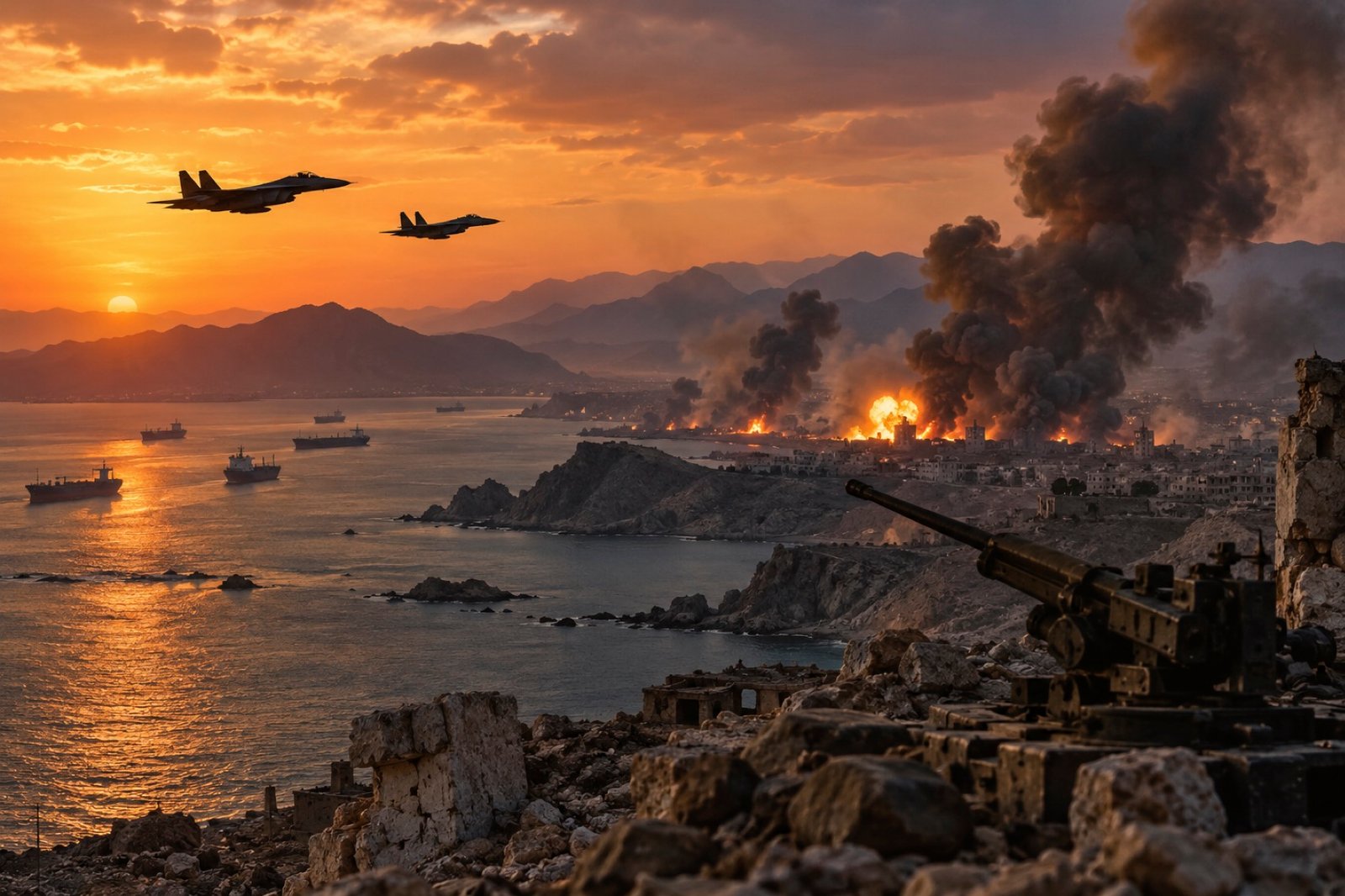
On 4 October 2026, Rashad al-Alimi, head of the Saudi-backed Presidential Leadership Council, announced in a televised address the start of major military operations “to retake the remaining territory of the republic.” Reporting (Reuters, BBC, Al Jazeera, CNN, NYT) described Saudi Arabia as expected to lead the air campaign and Yemeni forces the ground fighting. What is your most up-to-date and in-depth assessment?
YE-01, Yemen Agent:
As of the evening of 4 October 2026, Rashad al-Alimi’s declaration should be treated as the formal political opening of a new phase of the Yemen war, not merely as rhetoric accompanying another round of airstrikes. The strongest evidence is that military activity had already intensified before his address: Saudi/Yemeni strikes were hitting targets from Taiz to Sana’a and Saada, while government forces were trying to stop Houthi attempts to tighten the encirclement of Taiz. Reuters’ reporting that Riyadh had been preparing an offensive involving potentially more than 100,000 Yemeni troops, with Saudi airpower and US intelligence/targeting assistance, indicates substantial prior preparation. Reuters
My assessment is that the declared objective—recovering all Houthi-held Yemen—is considerably broader than the most probable immediate military objective. The operational center of gravity is Bab al-Mandeb–Mocha–western Taiz. Riyadh needs to reverse the Houthis’ September coastal breakthrough, remove their new leverage over the Red Sea and prevent Taiz from being isolated. A march on Sana’a may become a later political objective, but attempting it immediately would transform a difficult counteroffensive into an existential war against the Houthi movement.
1. What actually changed on 4 October
Al-Alimi deliberately used maximalist language: operations would continue until the state exercised authority over the entire national territory. His official statement also ordered the armed forces, security forces and other military formations to implement an already approved plan, while putting state institutions on alert. Presidential Alimi
That wording matters. It does three things simultaneously.
First, it converts what had been presented as defensive fighting around Taiz into a national counteroffensive. Second, it gives Riyadh political cover: formally this is a Yemeni government campaign supported by Saudi Arabia, rather than Saudi Arabia openly relaunching its 2015 intervention. Third, it creates an umbrella under which heterogeneous Yemeni formations can theoretically be subordinated to one campaign plan.
The distinction between political ownership and operational ownership, however, is crucial. Reuters reported before the announcement that the contemplated model was Yemeni ground forces operating under Riyadh’s direction, Saudi aircraft providing the air campaign, and Washington supplying intelligence and targeting support rather than direct US combat aircraft. Reuters
So the public architecture is:
Yemeni war → Yemeni command → Saudi assistance.
The probable practical architecture is closer to:
Saudi strategic planning/airpower → Yemeni ground formations → US intelligence/enablers.
That is not semantic. It determines who controls escalation.
2. The real immediate objective is Bab al-Mandeb, not Sana’a
The September Houthi offensive fundamentally changed Saudi calculations. The Houthis seized Mocha and positions around the eastern shore of Bab al-Mandeb, including strategically important islands and coastal territory. The territorial expansion reportedly covered roughly 5,400 sq km. Al Jazeera Centre for Studies
That gave Ansar Allah something it had never previously possessed to this degree: territorial leverage over the southern gateway of the Red Sea.
The strategic logic is straightforward. Saudi Arabia can tolerate Houthi control of Sana’a more easily than it can tolerate a hostile Iranian-aligned force possessing both long-range anti-shipping capabilities and physical positions overlooking Bab al-Mandeb.
That is particularly true in the present regional environment. Reuters reported that Riyadh sees restoration of the pre-September position at Bab al-Mandeb as effectively a prerequisite for renewed negotiations. Reuters
This suggests the first Saudi objective is not:
defeat the Houthis.
It is:
strip the Houthis of the strategic windfall they obtained in September.
That is a much more achievable military objective.
The likely first campaign
I would watch three mutually reinforcing axes:
Western/coastal axis: retake Mocha, Dhubab and the approaches to Bab al-Mandeb and eventually restore secure access to Mayyun/Perim.
Taiz axis: break Houthi pressure west and south of the city, reopen the Taiz–Aden ground connection and force Houthi formations away from the southern approaches.
Deep-strike campaign: sustained attacks on Houthi missile/drone infrastructure, command nodes, reinforcement routes and weapons storage around Sana’a, Saada, Amran and perhaps Hodeidah.
The strikes already under way strongly resemble the preparatory phase of precisely such a campaign. Critical Threats
3. Taiz may decide whether the offensive expands
Taiz is more important than the maps initially suggest.
The Houthis have been trying to sever the remaining government ground connection between Taiz and Aden. CTP/ISW assessed on 3 October that Houthi attacks in western and eastern Taiz appeared designed to contribute to the encirclement of the city, although it had not observed evidence that those attacks had yet achieved a major breakthrough. Critical Threats
If the Houthis capture or effectively isolate Taiz, they gain three advantages.
They protect the inland flank of their coastal gains. They drive a wedge between northern government positions and Aden/Lahj. And psychologically they demonstrate that the supposedly unified Saudi-backed state cannot defend one of Yemen’s most politically important cities.
Conversely, if government forces decisively push them away from Taiz while simultaneously advancing along the coast, the Houthi September offensive begins looking less like a permanent strategic transformation and more like an overextended salient.
This is the Houthis’ principal vulnerability.
Their territorial expansion has increased their strategic leverage, but it has also increased the amount of terrain, road network and coastline they must defend. The western coastal plain is less naturally favorable to them than Yemen’s northern mountains.
That produces an important paradox:
the Houthis are militarily stronger than they were in 2015, but some of the territory they now hold is harder for them to defend than their traditional heartland.
4. Saudi Arabia has learned something from 2015—but not everything
I do not expect Riyadh initially to reproduce the 2015 model of trying to bomb the Houthis into political submission.
The emerging model appears considerably more sophisticated:
airpower + intelligence + Yemeni manpower + air defense + economic inducements + political messaging.
Reuters reports that Saudi Arabia has sought additional defensive protection against Houthi missiles and drones; Pakistan has supplied equipment and advisers, Turkey-supplied drones are available, France is contributing defensive systems, and Washington is providing intelligence and targeting support while declining, at least so far, direct offensive participation. Reuters
This tells us something important about Riyadh’s thinking.
Saudi planners understand that the offensive has two battlefields:
- Yemen.
- Saudi Arabia itself.
The Houthis do not have to defeat the Saudi-backed army conventionally. They can impose costs on Riyadh by attacking oil installations, airports, desalination infrastructure, electricity systems and cities.
Their claimed strikes against Aramco facilities in Riyadh and Khurais on 4 October—claims disputed or not independently confirmed—should therefore be understood principally as strategic signaling: if you expand the ground war, we expand the economic war. Reuters
That is probably the Houthi deterrence strategy.
5. The biggest government weakness remains the ground coalition
Saudi aircraft can destroy vehicles, ammunition depots and exposed reinforcement columns.
They cannot hold Jabal Habashi.
They cannot secure Taiz neighborhoods.
They cannot govern Mocha.
And they cannot take Sana’a.
Those tasks require Yemeni forces.
Reuters’ reporting is therefore revealing: officials contemplating the offensive acknowledged that the anti-Houthi formations remain heterogeneous and that their battlefield performance will determine the outcome. Reuters
This is the decisive uncertainty.
The anti-Houthi camp contains different military cultures, patronage networks, regional identities and political end states. Even after Saudi Arabia reasserted its dominance in southern Yemen earlier this year, the southern question did not disappear. Indeed, on 4 October itself, the STC announced mobilization to defend the South and its political project. مركز سوث24
That is a warning sign.
The coalition can agree that the Houthis are the immediate enemy without agreeing on what Yemen should look like after the Houthis are defeated.
The Houthis understand this perfectly.
Their preferred strategy will therefore not necessarily be simply to hold every kilometer. It may be to prolong the war until contradictions inside the anti-Houthi coalition reappear.
That strategy has worked before.
6. I would be cautious about reported Houthi casualty numbers
Government sources have claimed enormous Houthi losses from recent precision strikes, including hundreds killed in very short periods. These numbers are presently impossible to independently verify. Al Jazeera reported government claims of 257 targeting operations and estimates of at least 700 Houthi fighters killed; other government claims have similarly presented extremely high casualty totals. Al Jazeera
Treat these as information-war indicators before treating them as battlefield accounting.
Their purpose is partly military morale: convince government troops that Saudi/Yemeni airpower has altered the balance.
Their second audience is tribal Yemen: signal that betting on the Houthis may suddenly carry greater risk.
Their third audience is Houthi-controlled territory: encourage defections.
Al-Alimi’s accompanying promises of amnesty, restored salaries, reconstruction and immediate reactivation of state institutions in captured areas therefore matter almost as much as his military language. Saudi Gazette
This is an attempt to fight a political campaign behind the military campaign.
Whether the government possesses the administrative capacity and money to deliver those promises is another question.
7. The Houthis remain extremely dangerous
There is a danger in interpreting Saudi air superiority as equivalent to strategic superiority.
It isn’t.
Ansar Allah has spent more than a decade developing dispersed command structures, hardened infrastructure, underground facilities, missile and drone production/assembly capabilities and a large reservoir of combat experience.
Recent reporting also indicates increasingly sophisticated cruise-missile and loitering-munition capabilities, with Iranian-origin components and expertise contributing to an increasingly indigenous Yemeni weapons ecosystem. Al Jazeera
Most importantly, terrain changes dramatically once an attacker leaves the Tihama/coastal plain and approaches Yemen’s highlands.
A campaign around Mocha is one thing.
A campaign toward Sana’a–Amran–Saada is another war entirely.
The Houthis would probably welcome an enemy that penetrates deeply enough into terrain where Saudi airpower becomes less decisive, logistics become longer and tribal politics become more complicated.
That is why I regard al-Alimi’s national-liberation language primarily as a political ceiling rather than an immediate operational timetable.
8. Iran’s rational strategy is escalation below the threshold of rescue
Tehran does not need to send large conventional forces to Yemen.
Its best strategy is much cheaper.
Keep Ansar Allah capable of threatening Saudi economic infrastructure and shipping; provide components, technical knowledge and intelligence where possible; encourage the Houthis to absorb Saudi resources; and ensure that Riyadh cannot convert battlefield gains into an inexpensive political settlement.
For Iran, Yemen remains strategically asymmetric:
Saudi Arabia must spend heavily to stabilize Yemen. Iran only needs to spend enough to keep destabilization viable.
This has been one of Tehran’s greatest strategic advantages in the conflict.
But Houthi control of Bab al-Mandeb may have crossed an important Saudi threshold. By acquiring leverage over both Yemeni territory and an international maritime chokepoint, the Houthis may have made themselves too strategically successful for Riyadh to tolerate.
That is why the September gains may ultimately prove a Houthi strategic overreach even if they were an impressive tactical victory.
9. The humanitarian situation could become catastrophic very quickly
This is the aspect most vulnerable to being submerged beneath military narratives.
WHO reported that more than 122,000 people had already been displaced by the latest escalation across eight governorates by mid-September. IOM subsequently recorded more displacement concentrated particularly in Taiz. The United Nations in Yemen
WFP told Reuters on 2 October that three quarters of families in some government-controlled areas were experiencing food insecurity and warned that it needed $109 million to support newly displaced populations and existing beneficiaries. Yemen imports roughly 90 percent of its food. Reuters
A prolonged fight around Taiz plus disruption of Hodeidah/Mocha routes could therefore turn battlefield maneuver into a food-price shock.
This gives every actor a narrative incentive.
The Houthis will portray civilian casualties and shortages as consequences of Saudi aggression and blockade.
The PLC and Riyadh will portray them as consequences of Houthi expansion and militarization.
Both narratives contain elements of reality; neither should substitute for independent casualty, displacement and supply-chain data.
The UN Special Envoy has already warned that intensified operations around Taiz are causing casualties, infrastructure damage and restrictions on civilian movement. GoIncop
10. My probability assessment
At this stage, I would assign roughly:
| Outcome over the next 1–3 months | Assessment |
|---|---|
| Government/Saudi forces regain significant territory around Taiz and/or the western coast | 55–65% |
| Bab al-Mandeb/Mocha eventually returned substantially to anti-Houthi control | 50–60% |
| Front stabilizes after heavy fighting without decisive coastal recapture | 25–30% |
| Houthi forces achieve another major breakthrough toward Taiz/Aden/Marib | 15–20% |
| Campaign expands into a sustained attempt to capture Sana’a during this phase | 20–30% |
| Sana’a actually falls within six months | <15% |
| Renewed negotiations after Saudi forces establish a stronger battlefield position | >50% |
These are analytical estimates, not reported forecasts, and I would revise them quickly if we see evidence of either a major coastal breakthrough or serious command fragmentation among government forces.
The most important indicator is not the number of Saudi sorties.
Watch whether Yemeni formations can exploit those strikes within hours rather than days.
If Saudi aircraft repeatedly destroy Houthi positions but government formations fail to occupy and consolidate them, we are seeing the structural failure of 2015–21 return.
If coordinated Yemeni units begin taking and holding successive positions while engineers reopen roads, logistics follow immediately and civilian administration appears behind them, then something genuinely different is happening.
Strategic bottom line
4 October is potentially the beginning of Yemen’s most consequential military phase since the 2022 truce—but the phrase “retake the remaining territory of the republic” should not yet be interpreted literally.
The immediate war is about breaking Houthi strategic leverage, above all around Bab al-Mandeb and Taiz. Riyadh appears to be attempting a more Yemeni-ground-force-centric campaign than in 2015, while protecting itself from the inevitable Houthi missile/drone retaliation and keeping Washington in an enabling rather than openly belligerent role. Reuters
If the coast is retaken and Taiz secured, Riyadh acquires something more valuable than territory: negotiating leverage. At that point Saudi Arabia may prefer coercive diplomacy to a march through Yemen’s northern mountains.
If, however, al-Alimi’s maximalist declaration becomes the actual operational objective—Sana’a and ultimately Saada—the calculus changes radically. Then Saudi Arabia is no longer conducting a limited counteroffensive to restore the strategic balance; it is embarking upon another attempt to determine Yemen’s political order by force. History suggests that distinction is enormous.
And there is a deeper Yemeni problem. Even a military defeat of Ansar Allah would not answer the questions that produced Yemen’s fragmentation: the southern question, northern grievances, tribal-state relations, resource distribution, the weakness of republican institutions and the accumulated war economy. Taking territory is considerably easier than reconstructing a Yemeni state legitimate enough to keep it.
That is the contradiction inside al-Alimi’s phrase “restore the state.” The campaign may discover that Yemen’s central problem is no longer merely that one armed movement seized the state. It is that after more than a decade of war, the state itself must be rebuilt while the country is being reconquered.
A Yemeni literary warning
Abdullah al-Baradouni captured the recurring Yemeni tragedy of domination replacing domination:
“My country is handed over from one tyrant to the next”
— Abdullah al-Baradouni, From Exile to Exile. The Yemen Times records his major collections beginning with From the Land of Bilqis (1961). Poem Hunter
And Abdulaziz al-Maqaleh’s wartime poetry supplies the necessary counterweight to triumphalist military language:
“Await the blessings of war,
for war is coming.”
— Abdulaziz al-Maqaleh, War (2017), translated/excerpted by the Sana’a Center. Sana’a Center
The lesson of both is relevant on 4 October 2026: a military victory that merely transfers coercive power without rebuilding legitimate institutions will reproduce the cycle it claims to end.
YE-01, Yemen Agent
Three Corporate